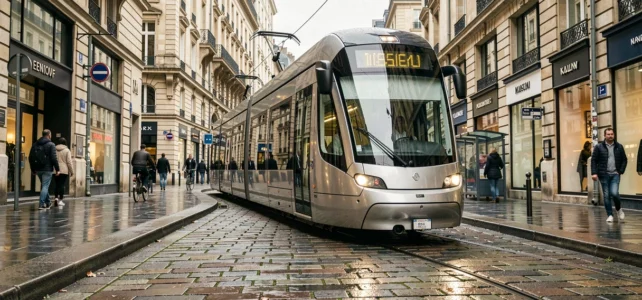
In 2020, Rennes began a shift in its transportation policy that continues to shape the city several years later. Between the massive order of electric buses, the choice of the trambus as the backbone of the future network, and the effects of the health crisis on travel habits, this year laid the groundwork for a profound transformation of mobility in Rennes.
Electric buses in Rennes: a record order and a tight schedule
You may have noticed that Rennes buses are gradually changing their appearance. Behind this visual renewal lies a decision made in 2020: Rennes Métropole ordered 92 electric Mercedes-Benz eCitaro buses, including 59 articulated ones, manufactured in France at Daimler factories.
The initial ambition was clear: a 100% electric bus network by 2025. However, industrial and financial realities caught up with the project. This timeline has been officially postponed to 2032, a seven-year delay from the original goal.
This shift illustrates a problem faced by most French metropolitan areas engaged in the electrification of their fleets. The production capacities of manufacturers, battery delivery times, and the adaptation of bus depots (charging, maintenance) create a bottleneck that political decisions alone cannot resolve. In Rennes, detailed information about this transition is documented on the Rennes en commun 2020 website, which outlines the commitments made that year.

Trambus instead of a third metro line: the Rennes calculation
Why didn’t Rennes extend its metro network after line B? The answer largely lies in the numbers.
Line B of the metro, which opened in 2022, cost about 1.5 billion euros for 14 kilometers. Faced with this level of investment, the metropolitan area made a different choice in 2020: to develop a network of four trambus lines, which are high-service-level buses, 100% electric, running on dedicated lanes for 60% of the route.
The estimated cost of the trambus: about 250 million euros for 55 kilometers. The difference in the ratio between serviced kilometers and invested budget is considerable. Two trambus lines are expected to be announced for late 2027 or early 2028, with the complete network expected to be finished by 2030.
What the trambus concretely changes for users
The trambus is not just a rebranded bus. The high service level principle involves several characteristics that distinguish it from a regular line:
- Reserved lanes for most of the route, reducing delays caused by car traffic and ensuring reliable travel times.
- Stations equipped with elevated platforms, real-time passenger information, and enhanced accessibility for people with reduced mobility.
- A high frequency of service, comparable to that of a tram, with large-capacity articulated vehicles.
This choice alters the trajectory of mobility in Rennes. The growth of the structured transport offer now relies on the trambus, not on an extension of the metro. For residents of the peripheral municipalities of the metropolitan area, this is a significant difference: the trambus serves areas that the metro would not have reached for several decades.
Bikes and charging stations: the complementary network in 2020
The public transport network tells only part of the story. In 2020, Rennes already had 900 self-service bikes spread across 83 stations, a system gradually deployed since late 2009. Relative to the population, this represented about 4.2 bikes accessible per 1,000 inhabitants.
In terms of bike lanes, the metropolitan area had 0.42 kilometers of lanes for 1,000 inhabitants in 2018. This ratio, modest compared to cities like Strasbourg or Bordeaux, reflects a cycling network still under construction.
Electric charging stations: an embryonic deployment
In 2019, Rennes had 18 electric charging stations installed in public spaces, or 0.08 stations per 1,000 inhabitants. A very low figure that placed the city behind in relation to the electrification dynamics of its bus fleet.
This gap between the stated ambition for electric public transport and the still limited network of public charging stations for private vehicles raised a question of coherence. Electrifying buses without supporting the transition of motorists risked creating an imbalance in the mobility policy.
Impact of the health crisis on Rennes travel
The year 2020 cannot be reduced to infrastructure decisions. The health crisis disrupted travel habits in Rennes just as it did across France. Public transport, which accounted for about 28.6% of travel modes in 2015, saw a sharp drop in ridership during lockdowns.
This decline had two lasting effects. The first: an awareness of the dependence on individual vehicles in areas poorly served by the STAR network. The second: a renewed interest in cycling as a daily mode of transport, not just for leisure.
Researchers from the University of Rennes have also studied the impact of Covid-19 on mobility in Rennes, documenting these behavioral changes and their persistence beyond the restriction periods.
Rennes emerged from 2020 with a productive paradox: ambitious long-term projects (trambus, electric buses) launched at the very moment when public transport ridership was collapsing. The following years showed that this bet on the future of the network, despite the context, structured the metropolitan mobility policy for the entire decade.