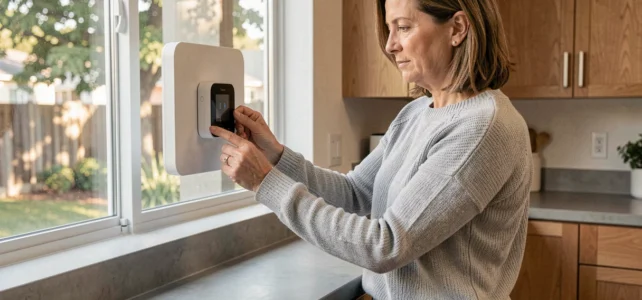
Home energy management is no longer limited to lowering the thermostat or turning off standby devices. The technologies available today allow for adjustments to the load profile of the home, modulating consumption based on price signals, and utilizing control loops that did not exist a few years ago.
Dynamic pricing and hourly energy consumption management
Dynamic pricing represents a paradigm shift from traditional pricing options. Regulated by the Energy Regulatory Commission (CRE) since deliberation n°2021-135, it indexes at least half of the kWh price to the EPEX Spot wholesale market, with a price that varies hour by hour.
Some strictly dynamic offers are available to individuals, notably from Sobry (SoCap, SoFlex) and Frank Énergie, accessible only with an active Linky meter. The National Energy Mediator reserves these contracts for very informed consumers due to the high volatility and risk of unpredictable bills.
The real interest of these contracts lies in coupling with a management system. The technical sheets published on ag-energie.org document the various energy management architectures applicable to residential housing. Without the ability to shift usage (water heater, electric vehicle charging, washing machine) to the cheaper time slots, dynamic pricing becomes a risky gamble rather than a lever for optimization.

Home battery coupling and predictive algorithms: the optimization loop
By 2026, the coupling of home batteries, dynamic pricing, and artificial intelligence algorithms will represent the technical frontier of residential management. Sobry and Zendure have announced a partnership to offer an integrated solution: the battery stores electricity purchased during the cheapest hours and then releases it during peak pricing times.
The algorithm anticipates prices hour by hour by cross-referencing weather forecasts, the household’s consumption history, and spot market data. It is no longer a simple shift between peak and off-peak hours, but a continuous optimization over 24 sliding hours.
We observe that the profitability of this type of installation depends on three critical parameters:
- The price gap between the most expensive and the cheapest time slots on the spot market, which must be significant enough to cover the battery’s conversion losses (round-trip efficiency).
- The usable capacity of the battery relative to the household’s consumption profile, with under-sizing negating the benefits of storage.
- The reliability of the predictive algorithm, as forecasting errors directly translate into additional costs.
This type of system remains a significant investment. We recommend sizing it after analyzing at least six months of Linky consumption data to calibrate storage capacity based on actual usage rather than theoretical averages.
Home automation and technical management of residential buildings
Energy efficiency-oriented home automation has surpassed the stage of being a connected gadget. Current systems coordinate heating, ventilation, lighting, and roller shutters via a single communication bus (KNX, Zigbee, Matter). Centralized technical management can generate up to 30% energy savings on a single-family home, according to data relayed by Rexel.
The gain primarily comes from three mechanisms. Room-by-room regulation prevents heating unoccupied spaces. Fine hourly programming adjusts settings based on actual occupancy detected by presence sensors. The coordination of shutters with the solar cycle reduces heating needs in winter and cooling needs in summer.
The technical key remains the protocol. A closed (proprietary) ecosystem limits expansion possibilities and renders the system obsolete if the manufacturer stops support. The Matter protocol, standardized and interoperable, seems to be the most sustainable choice for a new installation today.

Tempo option and daily price signal: balancing electrical usage
Less sophisticated than pure dynamic pricing, EDF’s Tempo option remains an effective optimization lever for households equipped with non-electric supplementary heating. The principle is based on a calendar of colored days (blue, white, red) with significant price differences between the time slots.
Since August 2026, Tempo rates have been recalculated with the new regulated tariffs. The financial interest focuses on the household’s ability to drastically reduce its consumption on red days, which represent a minority fraction of the year but where the kWh reaches its highest level.
A Tempo simulator allows projecting potential savings based on consumption history. The result depends on the differential between blue and red days, and especially on the household’s actual flexibility. A fully electric household without an alternative heating source will struggle to eliminate its consumption on red days without compromising comfort.
Load profile analysis: the prerequisite for any optimization
Before investing in a battery, a dynamic contract, or a home automation system, the crucial step remains the analysis of the load profile. The Linky meter provides consumption curves at half-hour intervals, accessible via the Enedis customer space.
Identifying controllable consumption items (water heater, vehicle charging, appliances) and their relative weight in the bill conditions the choice of solution. A household whose majority of consumption is inelastic (lighting, computing, cooking) will derive little benefit from a dynamic contract.
We recommend cross-referencing Linky data with a sub-metering device by circuit, which breaks down consumption item by item. This granularity often reveals anomalies invisible on the overall curve: a poorly programmed water heater, a heating circulator running continuously out of season, or a standby device whose residual consumption far exceeds what one might imagine.
Optimizing daily energy consumption now relies on measurement and management tools that transform the household into a regulated system. The profitability of each solution is calculated based on real data, not on national averages. It is this prior analysis that separates a relevant investment from a technological purchase without measurable return.