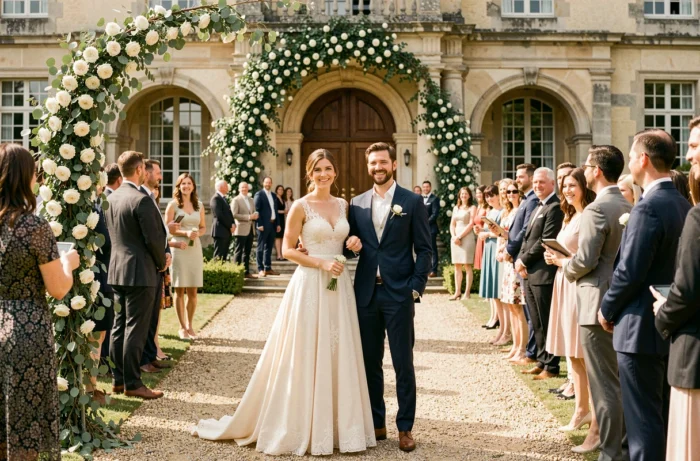
The welcome of guests at a wedding shapes the perception of the entire day. The first minutes at the reception venue set the level of comfort, orientation in the space, and the feeling of being expected. Taking care of this step requires preparation that goes beyond simple entrance decoration: parking logistics, management of arrival flows, and accommodating various profiles (elderly guests, children, guests with disabilities).
Wedding Welcome and Accessibility: An Often Overlooked Aspect of Organization
Most welcome guides focus on aesthetics (welcome signs, cocktails, floral decorations). Very few address the actual accessibility of the reception venue for all guests.
An accessible venue does not guarantee a smooth welcome. The width of doors, the nature of the ground between the parking lot and the entrance, the presence of even low steps, and the distance between parking and the hall: every detail can turn the arrival of a guest in a wheelchair or an elderly person into an obstacle course.
Before signing with a venue, check these points during a physical visit, not just through photos. For hearing-impaired guests, provide at least a written support of the day’s program. A printed plan with schedules, locations for each step, and the names of reference people avoids isolation situations from the very first minutes.
Additionally, the welcome techniques on Passion Mariage detail the coordination between different welcome posts and the management of staggered arrivals.
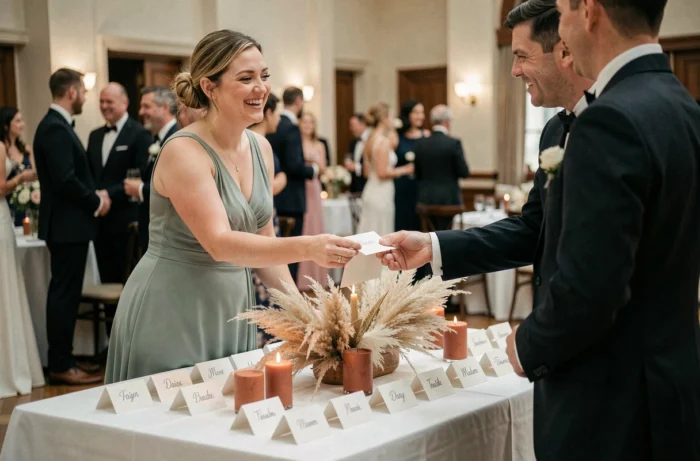
Signage and Orientation at the Reception Venue: What Really Works
Wedding signage is not just a pretty wooden sign at the entrance of the estate. Effective directional signage starts on the access road, sometimes several hundred meters before the gate, especially for isolated venues in the countryside.
Combined Physical and Digital Supports
The trend towards “phygital” weddings is confirmed: couples are combining clean paper supports with QR codes linking to a personal wedding website. This site gathers detailed programs, travel information, nearby accommodation options, and an interactive access map.
This approach reduces the number of documents distributed and improves guest orientation even before their arrival. However, it assumes that all guests have a charged smartphone and network connectivity on-site, which is not always the case in rural areas.
A paper duplicate remains necessary for guests who are less comfortable with digital tools. Provide a printed plan in each partner hotel room and a few copies at the entrance of the venue.
Concrete Landmarks to Install
- Directional signs at every intersection of the estate, readable from a distance (sufficiently sized lettering, strong contrast between text and background)
- A physical welcome point with one or two identifiable people (badge, recognizable outfit) capable of answering practical questions: parking, cloakroom, restrooms, children’s area
- Specific signage for the cocktail, reception hall, and ancillary spaces (smoking area, breastfeeding corner, play area), especially if the venue has multiple buildings
Micro-Wedding and Slow Wedding: Rethinking the Welcome by Guest List Size
The rise of so-called “slow” weddings and micro-weddings profoundly changes the welcome logic. Reducing the guest list allows for more investment in each person present. Welcome party the night before, personalized gifts, gourmet menus tailored to each person’s dietary restrictions: the smaller format makes these attentions feasible without blowing the budget.
A wedding spread over an entire weekend also changes the pace of the welcome. Guests no longer arrive all at once on Saturday morning. The welcome becomes a continuous process, with arrivals spread over Friday evening and Saturday, requiring different organization.
For a large wedding, this personalization remains possible as long as it is segmented. Prepare targeted attentions for the groups that matter most (close family, witnesses, long-time friends) rather than aiming for identical treatment for every guest.
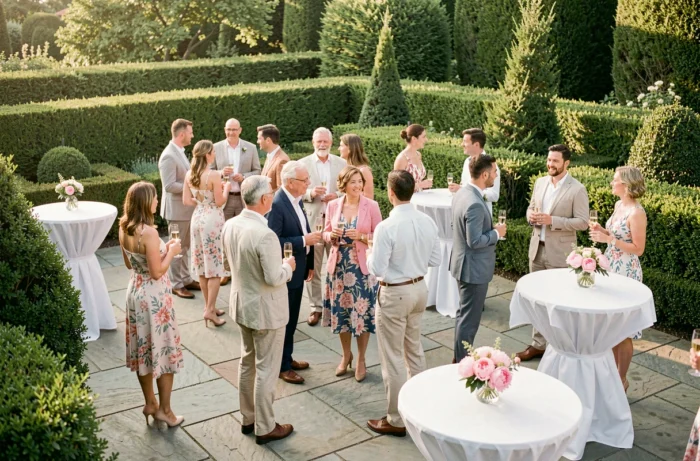
Coordination on the Big Day: Who Does What at the Wedding Welcome
The couple cannot welcome their guests. This is a logistical reality: between photos, the ceremony, and managing unforeseen events, the newlyweds are rarely available at the precise moment the first guests cross the entrance.
Designating two to three trusted individuals as welcome coordinators changes the game. These individuals must know the program, be aware of the locations of different spaces, and be capable of managing an unexpected arrival (unconfirmed guest, last-minute food allergy).
What the Welcome Coordinator Should Have on Hand
- The final guest list with any specific details (dietary restrictions, reduced mobility, young children)
- The hourly schedule for the day with acceptable delays for each step
- The direct contact information for the caterer, DJ or musician, and the venue coordinator to resolve a problem without disturbing the couple
- A practical emergency kit: phone charger, umbrellas, first aid kit, safety pins
The day coordinator must be able to make decisions without the couple’s validation. Define in advance the thresholds for autonomous decision-making: delaying the cocktail by fifteen minutes, reassigning a table seat, managing a parking issue.
The welcome of a wedding relies on invisible preparation, the kind that guests do not see but feel the effects of. Thoughtful signage for those with limited mobility, a trained reference person familiar with the day’s program, a reception format calibrated to the actual number of guests: these concrete choices transform a chaotic arrival into a controlled first impression.