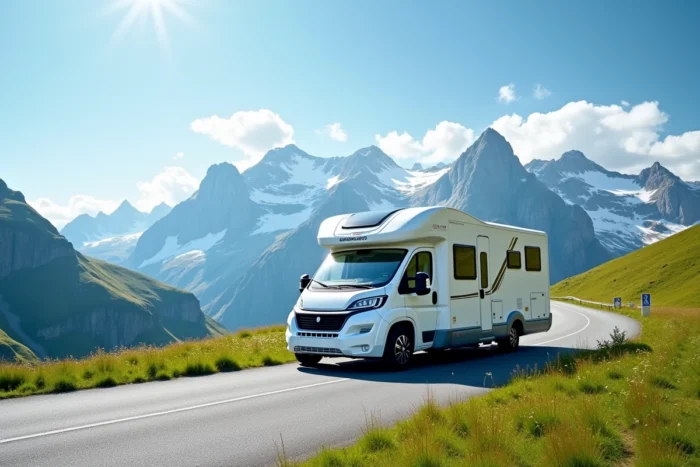
The Petit Saint Bernard Pass reaches an altitude of 2188 meters, at the Franco-Italian border. For motorhome travelers, this route between Haute-Tarentaise and Aosta Valley offers a direct alternative to the Mont-Blanc tunnel, without tolls. However, the road (RD 1090 on the French side) is subject to seasonal constraints, size restrictions, and summer parking saturation that should be considered before hitting the road.
Access to the Petit Saint Bernard Pass: what regulations impose on motorhomes
Traffic on the pass road is closed in winter, usually from late October to early June depending on snow conditions. Since 2021, the Montagne Law applies on RD 1090 from November 1 to March 31, requiring the presence of winter tires marked 3PMSF or chains on board, even though the pass road is blocked during this period.
In summer, vehicles over 3.5 tons may face restricted access depending on weather conditions and current prefectural orders. Before heading up, checking the road conditions with the tourist information office located directly at the pass is useful: it is open in July-August from 10 AM to 6 PM, with reduced hours in September.
Those preparing the Petit Saint Bernard Pass in a motorhome will find details on accessible parking areas and duration limits that vary from one municipality to another along the route.

Travel period and road conditions: June and September rather than July-August
Field reports converge on one point: June and September offer the best conditions for crossing the pass in a motorhome. Traffic is smoother, parking areas are less crowded, and temperatures are more stable, reducing the risk of engine overheating during long climbs.
In July-August, parking near the summit fills up quickly, sometimes as early as late morning. Some free spots become inaccessible due to lack of space, forcing drivers to descend several kilometers to find suitable parking for a motorhome.
Ascent from Bourg-Saint-Maurice and La Rosière
From Bourg-Saint-Maurice, the ascent via RD 1090 passes through Séez then La Rosière before reaching the pass. The road is wide and well-maintained, suitable for vehicles of 7 meters and more according to testimonials from motorhome travelers who have taken the route with 7.50-meter motorhomes. The hairpin turns are reasonable compared to other alpine passes.
The descent on the Italian side towards La Thuile requires more attention: the road is narrower in places, and passing other wide vehicles may require maneuvering.
Parking at altitude: equipped areas and practical limits
Parking areas accessible to motorhomes are not all located immediately near the pass. Several are situated below, a few kilometers from the most remarkable viewpoints. Height barriers or time limits exist depending on the municipalities crossed.
- Parking at the pass (2188 m): a few spots exist near the tourist information office, but they fill up quickly in high season and not all have services (water, waste disposal)
- Downstream parking on the French side (La Rosière area): more spacious, sometimes equipped with service points, but further from the summit
- On the Italian side (La Thuile): parking areas tolerate motorhomes, with variable conditions depending on the season and Italian municipal regulations
Planning to arrive early in the morning remains the most reliable strategy to access spots close to the pass, especially between July 14 and August 15.
Panoramas and stops at the Petit Saint Bernard Pass: what justifies the ascent
The pass itself offers an unobstructed panorama of both slopes, with a view of the Mont-Blanc massif on the French side and the first Aosta Valley peaks on the Italian side. Several stops are worth making beyond just passing through.
- The alpine garden of Chanousia, located right at the pass, gathers high mountain species in a setting accessible on foot from the parking areas
- The remains of the Celtic cromlech, a classified stone circle, testify to the ancient human passage at this location
- The old hospice and the Joux column, historical landmarks visible from the road
- The hiking trails starting from the pass towards Lake Verney or Mount Valaisan, accessible for walks of a few hours
The tourist information office at the pass provides real-time weather conditions, planned events, and trail status, which avoids having to descend into the valley for this information.
Alternative to the Mont-Blanc tunnel: the calculation to make
Taking the pass instead of the Mont-Blanc tunnel eliminates the toll cost, which represents a significant amount for a round trip in a motorhome. The journey by road is longer in time, but the fuel consumed remains less than the price of the tunnel according to testimonials collected on specialized forums. Filling up with fuel on the French side before the ascent is recommended, as prices in Italy are higher.
The Petit Saint Bernard Pass is not just a shortcut to Aosta Valley. It is a route in its own right, with its logistical constraints (limited parking, road closed for a large part of the year) and its advantages (free access, landscapes, cultural stops). Arriving early, favoring the months of June or September, and checking conditions at the information office before heading up: these three reflexes are enough to turn the passage into a successful alpine stop.