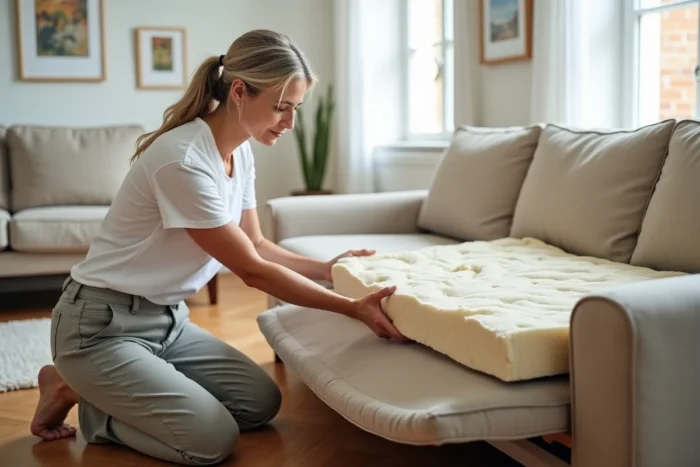
The foam of a Poltronesofa sofa is an assembly of custom-cut polyurethane, fitted into a wooden and steel structure, and then covered with a precisely tailored cover. Replacing this foam without understanding the specific constraints of the brand exposes one to mistakes that go far beyond mere comfort issues: loss of warranty, deterioration of the fabric, density incompatibility.
Poltronesofa Warranty and Foam Replacement: What You Really Risk
Poltronesofa considers the replacement of foam by a third party as a modification of the product. In practice, this intervention is enough to lead to a voiding of the manufacturer’s warranty, even if the defect reported later has nothing to do with the changed foam.
The problem arises especially when sagging appears a few months after purchase. If you have already replaced the seat foam, customer service will refuse to cover it, even for a structural or recliner mechanism defect. Before any intervention, check the expiration date of your warranty and weigh the balance between immediate comfort gain and the coverage you are giving up.
For sofas still under warranty, the safest approach is to report the defect directly in a Poltronesofa store, in writing, attaching dated photos of the sagging. This creates an actionable record in case of subsequent mediation.
When the decision to change the foam of a Poltronesofa sofa is made after the warranty has expired, the legal risk disappears, but technical errors remain numerous.
Polyurethane Foam Density: The Most Common Measurement Error
The density of the foam is expressed in kilograms per cubic meter. It determines resistance to sagging over time. Poltronesofa’s original foams are often reported to have modest density levels, typically around 30 kg/m³ according to consumer feedback.
Replacing with a denser foam seems logical. However, increasing the density without adjusting the dimensions creates a cushion that is too firm and too thick, which no longer fits into the cover or distorts the side seams. Conversely, choosing the same density replicates the initial defect.
Finding the Right Density-Thickness Compromise
The reflex to avoid: ordering foam solely based on the outer dimensions of the cushion. The Poltronesofa cover is cut for a precise volume of foam. A denser foam compresses differently, and a difference of just a few millimeters is enough to block the zipper or create unsightly wrinkles on the fabric.
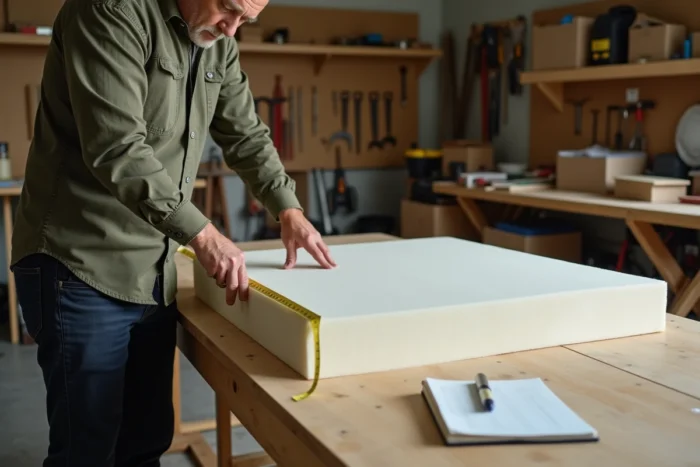
- Measure the original foam once removed from the cover, not the cover itself. The fabric may have stretched over time and no longer reflects the initial dimensions.
- Compare the height of the used foam to its theoretical thickness: if the difference exceeds one centimeter, the foam has lost its support and the cover has adapted to the sagged volume.
- Order a sample of the targeted density to test the compression by hand before investing in a full cut.
Non-removable Poltronesofa Cushions: The Assembly Trap
On paper, many Poltronesofa models are presented as removable. In reality, user feedback shows that zippers are sometimes nearly inaccessible, and some armrests are fixed in a way that prevents the removal of the fabric without forcing the structure.
Attempting to remove a cushion whose assembly is not designed for frequent disassembly exposes the fabric to tears, especially at the corners and along reinforced seams. The risk is higher on models with stretched coverings, where the fabric is stapled directly to the frame beneath the seat.
Identifying the Type of Assembly Before Starting
Turn the sofa over and inspect the underside of the seat. Two scenarios:
- A non-woven backing stapled: the foam is accessible by removing the staples, but they will need to be replaced properly to prevent the fabric from rubbing against the floor.
- A rigid panel screwed or glued: disassembly requires appropriate tools and precise marking of the fixing points, or risk splitting the structural wood.
- Hidden zippers in the folds of the fabric: gently pull while holding the fabric on either side to distribute the tension. Forcing on one side will tear the zipper teeth.

Hiring an Upholsterer for a Poltronesofa: What Concrete Benefits
A local upholsterer does not just cut foam to the right dimensions. They assess the condition of the structure (straps, springs, wooden frame) and can identify a problem that simple foam replacement will not resolve. Sagging may stem from a loose strap rather than worn foam.
Consumer forums report another concrete advantage: some upholsterers provide a written opinion on the initial quality of the foam and assembly. This document has been used by clients in claims or mediation cases with Poltronesofa, as evidence of a manufacturing defect.
The cost of visiting an upholsterer exceeds that of purchasing foam online, but it avoids sizing, density, and reassembly errors that turn a simple operation into a permanent degradation of the sofa.
Changing the foam of a Poltronesofa remains an accessible intervention, provided that each step is treated as a technical constraint and not just a simple cut. The warranty, density, type of assembly, and condition of the structure form a whole: neglecting even one of these parameters is enough to make the result worse than the initial problem.