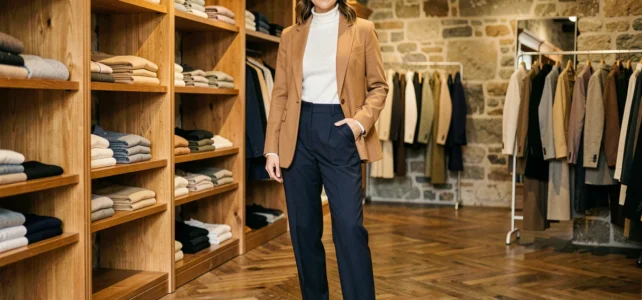
The frequency of clothing purchases in France has significantly declined compared to pre-2020 levels. Households are prioritizing cuts in fashion spending, and wardrobes are tightening around fewer pieces that are worn more often. In this context, adopting a trendy and assertive style on a daily basis no longer relies on the accumulation of new items but on the rigorous selection of what to keep, what to combine, and what to eliminate.
Cost per use: the criterion that separates a useful fashion purchase from a wasted one
Recent analyses of the fashion market in Europe describe a logic of practical premiumization: buying less, but better, by prioritizing wearable pieces in multiple contexts. The reflex to adopt before any purchase is to think in terms of cost per use, that is, the price divided by the number of times the piece will actually be worn.
| Type of piece | Estimated frequency of use | Versatility (contexts) | Cost per use |
|---|---|---|---|
| Structured blazer, neutral color | High (several times a week) | Office, outings, smart casual | Very low |
| Well-cut straight trousers | High | Office, weekend, travel | Very low |
| Seasonal printed dress | Moderate (one season) | Outings, vacations | Medium |
| Very trendy piece (ultra-dated cut or pattern) | Low (a few weeks) | One context only | High |
A blazer worn three times a week for two years results in a negligible cost per use, even when purchased at a premium price. A very trendy piece worn five times costs proportionally much more, regardless of its purchase price. An assertive style is built on high-rotation pieces, not on fleeting crushes.
To explore the combinations that work between basics and statement pieces, style on Mister Tendance details concrete associations suitable for different wardrobe profiles.
Algorithms and standardization: why your look resembles everyone else’s
TikTok and Instagram produce a strong homogenization of everyday silhouettes. Recommendation algorithms favor content that generates quick engagement, which pushes the same cuts, palettes, and piece combinations to the surface.
The result is visible on the streets: nearly identical outfits worn by very different profiles. This phenomenon, documented by several European media outlets in recent months, creates a paradox. The more one seeks inspiration online, the more one converges towards a mediocre style, smoothed out by virality.
Three levers to break free from the algorithmic loop
- Seek inspiration outside of recommendation platforms: photography books, cinema, archives of print magazines. These sources are not filtered by an algorithm optimizing click-through rates.
- Identify pieces that viral trends do not cover: textured materials (heavy linen, boiled wool, thick cotton), regional or artisanal cuts, niche accessories. What does not circulate on TikTok is not dated by TikTok.
- Set your own wardrobe constants: a palette of three or four recurring colors, a type of collar or trouser cut, a signature accessory. An assertive style relies on repeated choices, not on variety.
Singularity does not come from the accumulation of original pieces. It comes from the coherence between what one wears and how one wears it, day after day.
Modular layering: building a look with layers rather than isolated pieces
The winter 2026/2027 collections in Europe structure their proposals around modular layering systems: technical coats, comfortable knits, adjustable overlays according to context and weather. This approach is not only functional; it changes the way an outfit is visually perceived.
A look composed of two layers gives a flat silhouette. Three well-chosen layers create volume, contrast of materials, and a look that stands out effortlessly. The technical rule is simple: each layer must be visible somewhere (collar, hem, sleeve, texture in transparency).
Layer combinations that work daily
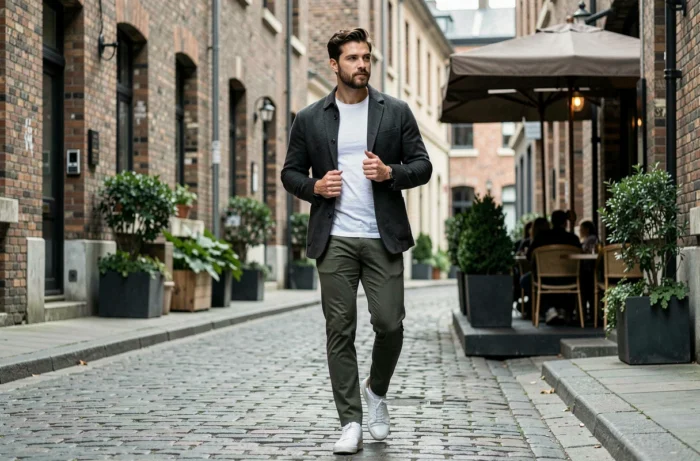
A round-neck t-shirt under an open shirt, all under a slightly oversized blazer, creates a play of volumes and textures that the shirt alone does not create. In contrast, stacking three thick knit layers without material contrast gives a massive effect without structure.
Effective layering contrasts materials: fluid against rigid, matte against shiny, thin against thick. A straight wool trouser paired with a brushed cotton sweatshirt and a technical jacket creates three distinct textures. The contrast of materials replaces the need for bright colors to capture attention.

Accessories and details: what distinguishes a composed look from a thrown-on look
In a tightened wardrobe, accessories are the most cost-effective differentiation lever in terms of cost per use. A belt, a pair of sunglasses, or a scarf worn consistently become personal markers that anchor a style.
The difference between a composed look and a thrown-on look often hinges on a single intentional element: rolled-up sleeves at a precise fold, a belt that cinches the waist on an oversized piece, a watch or bracelet consistently worn on the same side. A detail repeated every day builds a recognizable look.
Market data confirms that consumers are directing their fashion purchases towards highly versatile pieces. A well-chosen accessory multiplies the possible combinations with a reduced wardrobe, aligning daily elegance with budget constraints.
Adopting an assertive style daily comes down to a discipline of selection. Fewer pieces, worn more often, intentionally combined. The trendiest garment in your wardrobe is the one you wear enough for it to become yours.