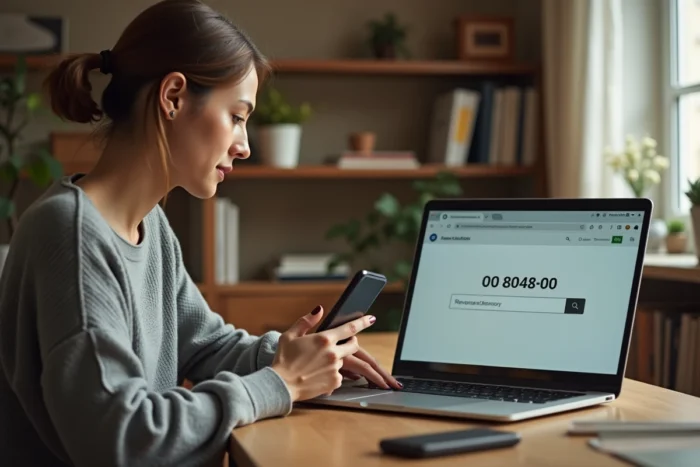
A reverse directory works in the opposite way of a traditional directory: instead of searching for a number based on a name, you enter a phone number to obtain the identity of its owner. The principle relies on databases that cross-reference landline, mobile, and sometimes business lines with the information declared by operators or the users themselves.
Partial results, data collection: the traps of false free services
Most services that claim to be free operate on a two-step model. The initial search displays a truncated result (city, operator, line type), then a screen prompts you to subscribe to access the full name of the owner.
This lock-in is not always clearly announced. Some sites require email or phone number registration even before displaying any results. This step serves less to verify the user’s identity than to collect personal data sold to third parties.
To spot these services, three signals deserve attention:
- The site displays a vague result (approximate location, operator name) and then redirects to a payment or subscription page for the name associated with the number.
- Registration requires a credit card number, even for a “free trial,” with automatic renewal mentioned in small print.
- The terms of service provide for the transfer of collected data to commercial partners unrelated to the reverse search service.
A truly free service displays its results without an intermediate payment screen. If the searched number is in its database, the name is displayed directly. Otherwise, the response is simply “number not listed.” Finding an effective and free reverse directory therefore requires checking this behavior before entering your own details.

Fixed and mobile reverse directories: very different databases
Reverse search on a landline number in France generally yields good results. Landline numbers are linked to subscriptions declared with operators, and a large part of this data feeds public directories like PagesBlanches.
Mobile numbers are much less covered by free reverse directories. Their owner can oppose the publication of their details in the universal directory, and the majority of mobile subscribers exercise this right. A free service claiming to identify all mobile numbers relies either on outdated data or on a community mechanism.
The community identification model
Applications like Truecaller adopt a different approach from the traditional directory. Their database is built from the address books shared by users who install the application. When a user allows access to their contacts, all the names and numbers they have saved contribute to the collective database.
This model allows for the identification of mobile numbers absent from official directories. Truecaller claims a community of several hundred million users worldwide. The trade-off is direct: by installing the application, the contacts in your own directory become accessible to other users, without the concerned individuals having given their consent.
Reverse search and unwanted calls: two distinct uses
Identifying the source of a missed call and blocking spam calls are two needs often confused, but which fall under different technical services.
A reverse directory addresses the first situation: an unknown number appears, and the search allows you to find out if it corresponds to a professional, an individual, or a premium number. The response is punctual. The directory does not filter anything; it identifies afterward.
Filtering unwanted calls works upstream. Dedicated applications compare each incoming call to a blacklist fed by reports from other users. If the number has been reported as spam or telemarketing, the call is blocked or redirected automatically. This real-time filtering has nothing to do with a directory consultation.
The anti-telephone scam law of 2025 strengthens this framework by imposing new obligations on operators to combat fraudulent calls. This text gradually shifts the responsibility for filtering to the operators themselves, reducing dependence on third-party applications for blocking unwanted numbers.
Geographical scope: a reverse directory only covers one country
The databases of reverse directories are constructed on a national scale. A French service queries the data of French operators and the registrations in the universal directory managed in France. A foreign number will not return any results on a French reverse directory.
This fragmentation explains why no free service offers reliable global coverage. Data protection regulations vary from country to country, and operators do not share their files beyond borders. For a Belgian, Quebecois, or American number, a service specific to the concerned country must be used.

Services that display an “international” flag on their homepage most often rely on the community model described above, with very uneven coverage depending on the countries. The reliability of the result then depends on the number of active users in the geographical area of the searched number.
Before launching a reverse search, checking the international prefix of the number helps direct the request to the right service. A number starting with +33 falls under French directories, a +32 under Belgian directories, a +1 under North American directories. The choice of tool conditions the relevance of the result as much as the quality of its database.