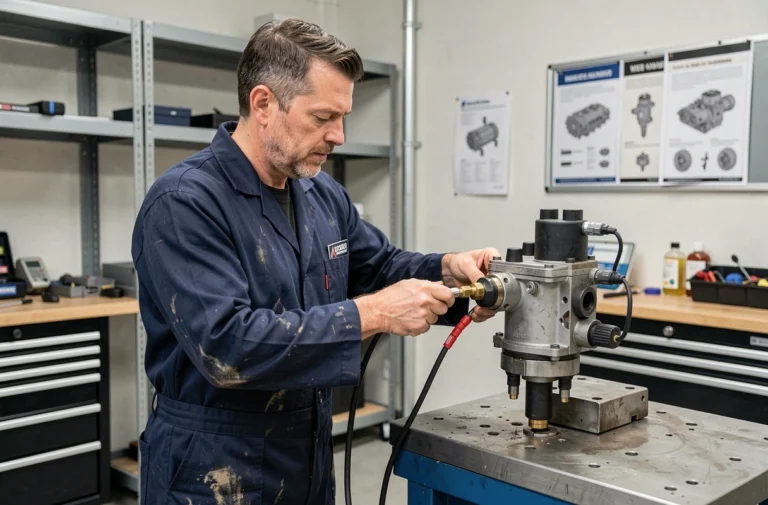
On the Polo 5 petrol (6R/6C), the orange engine light corresponds to a fault recorded by the engine control unit (ECU) via the OBD-II protocol. The indicator signals an anomaly related to the powertrain or the emissions control system. A steady light indicates a stored fault without immediate urgency, while a flashing light indicates active misfires that can damage the catalytic converter within minutes of driving.
Specific fault codes for TSI and MPI engines of the Polo 5
The petrol engines of the Polo 5 are divided between atmospheric MPI blocks (1.2 60/70 hp) and direct injection TSI blocks (1.2 TSI, 1.4 TSI). The fault codes and associated failures differ significantly from one architecture to another.
On the 1.2 MPI three-cylinder, misfires (P0300 to P0303) occur frequently. We observe that individual ignition coils and original spark plugs degrade faster than indicated by the maintenance schedule, especially on repeated short trips. An isolated misfire on a cylinder (P0301, P0302, or P0303) primarily points to the coil or spark plug of the affected cylinder, rarely to the injector on this type of block.
On the 1.2 TSI and 1.4 TSI blocks, the timing chain and its tensioner are documented weak points. Chain elongation alters the timing and generates codes related to camshaft/crankshaft correlation (P0016, P0017). The light then comes on with a metallic rattling noise at cold idle. Do not confuse this symptom with a simple ignition problem: continuing to drive risks a chain jump.
When an orange engine light on Volkswagen Polo 5 petrol appears without any noticeable symptoms, the fault code is often related to the fuel evaporation circuit (P0441, P0455) or the downstream lambda sensor (P0136, P0138). These faults do not affect immediate driving but will cause a failure in the technical inspection regarding emissions control.
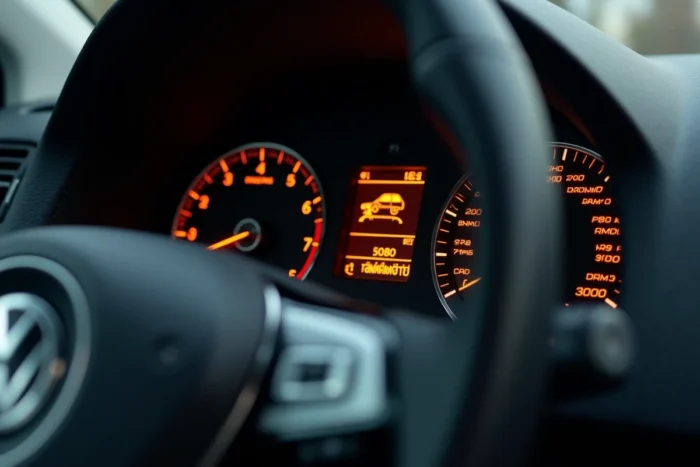
OBD-II diagnostics on Polo 5: reading and interpreting real-time data
Connecting a diagnostic tool or OBD-II reader to the port located under the steering wheel (driver’s side) allows for reading fault codes (DTC), as well as accessing real-time data. It is this second layer of information that distinguishes a reliable diagnosis from a simple code reading.
Parameters to monitor as a priority
- Short and long-term fuel trim (Short Term Fuel Trim / Long Term Fuel Trim): a value greater than +/- 10% on the LTFT indicates a mixture that is too rich or too lean. On Polo 5s running with a mixture containing E85 ethanol, we regularly observe an excessively positive LTFT, indicating that the ECU can no longer compensate for the mixture’s lean condition.
- Voltage of upstream and downstream lambda sensors: an upstream sensor stuck around 0.45 V or not varying between 0.1 and 0.9 V indicates a faulty sensor or a saturated catalytic converter.
- Coolant and intake temperatures: a faulty engine temperature sensor skews the cold injection calculation and triggers the light after a few starting cycles.
- Pressure in the fuel rail (TSI only): a pressure lower than the specification at idle points to the high-pressure pump or pressure regulator.
Clearing a fault code without identifying the cause amounts to masking the problem. The ECU will turn the light back on after a few driving cycles if the fault persists. On Polo 5s, the number of cycles required to validate the disappearance of a fault varies depending on the type of OBD monitor involved.
Steady or flashing engine light: actions to take in the workshop
The distinction between steady and flashing is not cosmetic. A flashing light requires the vehicle to be stopped as soon as possible. Active misfires send unburned fuel into the catalytic converter, causing its internal temperature to rise well beyond its normal operating range. Replacing a catalytic converter on a Polo 5 represents a disproportionate cost compared to the vehicle’s purchase price.
A steady light allows for cautious driving to the workshop, provided no worsening symptoms manifest (loss of power, jerking, abnormal exhaust smell, temperature rise). We recommend not exceeding a few dozen kilometers and avoiding revs above 3,000 rpm.
Special case: engine light combined with the EPC light
On the Polo 5, the simultaneous illumination of the engine light and the EPC light (Electronic Power Control) indicates that the ECU has entered a limp mode. Power is deliberately limited. The most common causes are a clogged throttle body, a faulty accelerator pedal sensor, or a boost issue on TSI versions. Cleaning the throttle body with a reset of the adaptation value via the diagnostic tool resolves a significant portion of these cases.

E85 fuel and engine light on non-flexfuel Polo 5 petrol
Some Polo 5 petrol drivers use pure E85 ethanol or a high blend without an approved conversion kit. The original ECU is not calibrated to handle an ethanol content exceeding 10%. When the mixture becomes too lean beyond the LTFT’s correction capability, the engine light comes on with codes P0171 (too lean mixture) or P0300 (multiple misfires).
Switching back to SP95 or SP98 for a few tanks is often enough to lower the trims and turn off the light after a few cycles. However, repeated switches to E85 without material adaptation accelerate the wear of the injectors and fuel circuit seals, which are not designed to withstand concentrated ethanol on this generation of Polo.
The orange engine light on Polo 5 petrol always warrants a code reading before any mechanical intervention. Replacing parts at random (spark plugs, coils, sensors) without checking real-time data remains the primary cause of unnecessary bills on this model.