
The acronym LPD appears on most booking platforms, but its exact meaning and what it includes vary by establishment. Behind these three letters lies the formula “Accommodation + Breakfast,” a pricing structure that today underpins the majority of hotel offers in France and Europe. Understanding what LPD actually covers, and what distinguishes it from other meal plans, helps avoid budget discrepancies once on-site.
LPD as a pricing structure in booking engines
Several travel players in France and Europe now present the LPD formula first in their booking engines. Half-board or full-board options appear next as upgrades. This display choice is not trivial: it reflects a commercial logic where LPD serves as a loss leader to attract travelers who prefer to have lunch and dinner outside.
To find the definition of LPD in hotels on Azami Voyage, it should be noted that the term strictly covers the overnight stay and breakfast, nothing more. Any additional services (lunch, dinner, drinks) fall under a different pricing regime.
Modern hotel management systems (PMS) leverage this LPD base to create customizable packages. A hotel can start with the LPD rate and offer optional dining credits, a meal box for an excursion, or spa access. This approach transforms LPD into the foundation of an à la carte offer, far from the fixed package of traditional formulas.

Comparison of meal plans in hospitality
The differences between plans hinge on included meals, flexibility, and the level of financial commitment. The table below summarizes the concrete distinctions between each regime.
| Plan | Included Meals | Drinks | Flexibility |
|---|---|---|---|
| LPD (Accommodation + Breakfast) | Breakfast only | Not included (except breakfast) | Maximum: lunch and dinner free |
| Half-board (DP) | Breakfast + dinner (or lunch) | According to the establishment | Medium: one meal free |
| Full-board (PC) | Breakfast + lunch + dinner | According to the establishment | Low: all meals at the hotel |
| All-inclusive (AI) | All meals + snacks | Included (soft and/or alcoholic) | None: stay centered on the hotel |
LPD is the only plan that does not require any main meal. In half-board, dinner (generally) is taken at the hotel, which limits the exploration of local restaurants. In full-board, all three meals are served on-site.
What the table does not show
The price difference between LPD and full-board does not simply correspond to the cost of additional meals. Hotels incorporate a margin on captive dining. A traveler who chooses LPD and eats out may spend less than in full-board, depending on the destination and the standard of the hotel restaurant.
Conversely, in some countries where outside dining is expensive (island destinations, isolated resorts), full-board becomes economically more coherent than LPD combined with restaurant meals.
LPD and dynamic pricing: what has changed with modern PMS
The boundary between LPD and customizable packages has significantly narrowed. Current booking engines allow hoteliers to create hybrid offers based on the base rate.
- A F&B (food and beverage) credit added to the LPD rate, usable at the hotel restaurant or bar according to the customer’s desires
- Meal boxes offered as an option for excursion days, without switching to a classic half-board
- Packages combining LPD and activities (spa, guided tours, transfers), sold as a tailor-made stay
This modularity explains why LPD has become the commercial pivot for many establishments. It offers a clear entry price while allowing for upgrades through additional services. For the hotelier, each option sold as an extra generates additional revenue that is better controlled than an all-inclusive package where dining costs are pooled.
Impact on traveler choice
For a city stay or in a region rich in restaurants, LPD remains the most suitable plan. The traveler retains the freedom to explore local cuisine without paying twice for meals they will not have at the hotel.
For a stay in a resort or in an isolated area, full-board or all-inclusive reduces budget uncertainty. The choice depends less on the plan itself than on the geographical context and type of trip.
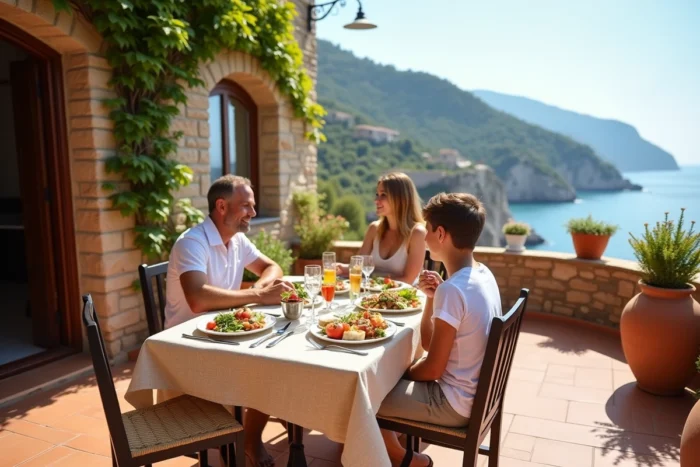
Decoding abbreviations on booking sites
Travel platforms use acronyms that vary by language and market. Here are the most common correspondences to avoid confusion when booking.
- LPD or B&B: accommodation + breakfast (bed and breakfast in English)
- DP or HB: half-board (half board)
- PC or FB: full-board (full board)
- AI or TI: all-inclusive
- RO or EP: room only, with no meals (room only / European plan)
The mention “room only” is sometimes confused with LPD. In room only, breakfast is not included, which represents a concrete difference on the final bill, especially in hotels where the buffet breakfast is charged separately.
When booking, checking the exact abbreviation in the order summary remains the most reliable way to avoid an unpleasant surprise upon arrival. Long descriptions in hotel listings do not always explicitly mention whether breakfast is included in the displayed rate.
The choice between LPD, half-board, or full-board boils down to a question of context: destination, length of stay, and desire to eat on-site or outside. LPD, as a customizable pricing base, leaves the decision to the traveler meal by meal, making it the most widespread formula on current booking engines.