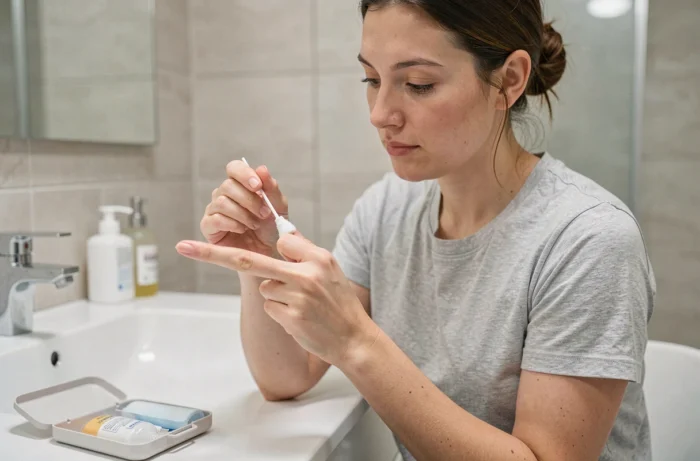
When a nail partially or completely detaches, the priority is on two measurable parameters: the risk of infection in the first hours and the healing duration in the following weeks. The choice of antiseptic, the type of dressing, and the frequency of care directly influence these two variables. Comparing the available options allows for the right actions to be taken without worsening the condition of the nail bed.
Antiseptic for a torn nail: chlorhexidine, Dakin, or alcohol
Not all antiseptics are equal on an open wound. The exposed nail bed is fragile tissue, much more sensitive than intact skin. Applying an unsuitable product can delay healing or cause chemical irritation.
| Antiseptic | Suitable for nail bed | Characteristics |
|---|---|---|
| Aqueous chlorhexidine | Yes | Colorless, non-alcoholic, broad-spectrum antibacterial |
| Dakin (diluted sodium hypochlorite) | Yes | Colorless, well tolerated on open wounds, mild antiseptic action |
| 70° alcohol | No | Burns on exposed tissue, drying, delays healing |
| Betadine (povidone-iodine) | With caution | Colored (masks wound evolution), possible iodine allergy |
Sources converge on a colorless and non-alcoholic antiseptic like chlorhexidine or Dakin. The benefit of a colorless product goes beyond simple skin tolerance: it allows for visual monitoring of the wound at each dressing change, without residual coloring that could mask the onset of infection.
Knowing how to disinfect a torn nail with the right product conditions the subsequent management. An alcoholic antiseptic causes intense pain and destroys regenerating cells on the nail bed, which prolongs the regrowth duration.
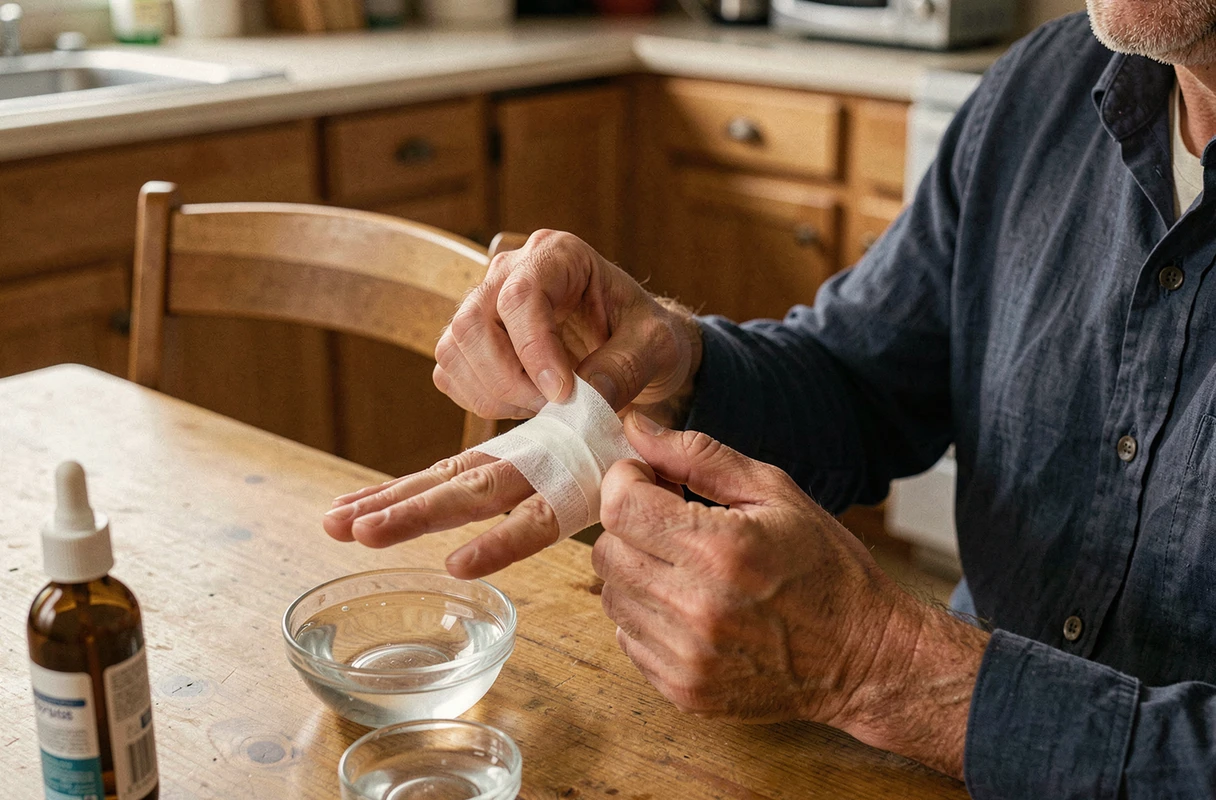
Cleaning and dressing the nail bed: daily care protocol
Before applying any antiseptic, the wound must be cleaned. The action is as important as the product.
Initial washing without scrubbing
Rinse the area under a stream of clear or lukewarm water with mild soap for one to two minutes. Never scrub the exposed nail bed: the tissue is thin, vascularized, and any mechanical abrasion worsens the injury. Then dry by patting with a non-linting compress, never with cotton which leaves fibers in the wound.
Choosing a non-adherent dressing
The type of dressing directly influences the quality of healing. A standard adhesive dressing stuck to the nail bed pulls off newly formed cells with each removal. The American Academy of Dermatology recommends applying a thin layer of petroleum jelly on the wound, then covering it with a sterile compress or gauze held in place by a bandage or adhesive tape fixed to the healthy skin around the finger.
- Apply petroleum jelly directly on the nail bed to maintain a moist environment favorable to cellular regeneration
- Cover with a non-adherent sterile compress, without tightening, to allow air circulation
- Change the dressing at least once a day, or as soon as it becomes soiled or wet
- Check at each change for the absence of extensive redness, pus, or unusual odor
A dressing changed daily reduces the risk of infection and allows for the detection of any signs of worsening before it requires an emergency consultation.
Partially torn nail: cut or leave in place
The management of a nail fragment still attached often divides patients. Pulling on it reflexively is the worst option: further tearing can damage the nail matrix, the growth area located under the base of the nail, and permanently compromise normal regrowth.
Never pull on a partially torn nail. If a edge is clearly detached and hinders the application of the dressing, it can be cleanly cut with disinfected nail clippers or scissors. The cut should follow the free edge without descending towards the matrix.
However, if the nail is still held on a large surface, keeping it in place with the dressing has a concrete advantage: it acts as a biological splint that protects the nail bed during the initial healing phase. The doctor will assess during the consultation whether this fragment should be kept or removed.
Signs of infection and medical consultation after nail trauma
The initial disinfection does not guarantee the absence of infection in the following days. The exposed nail bed remains a gateway for bacteria, especially if the dressing is not changed regularly or if the wound comes into contact with stagnant water.
- Redness that extends beyond the initial wound area, with a sensation of warmth
- Increasing pain after the first 48 hours instead of a gradual decrease
- Presence of yellow or greenish pus, sometimes accompanied by an odor
- Fever, even mild, in the days following the trauma
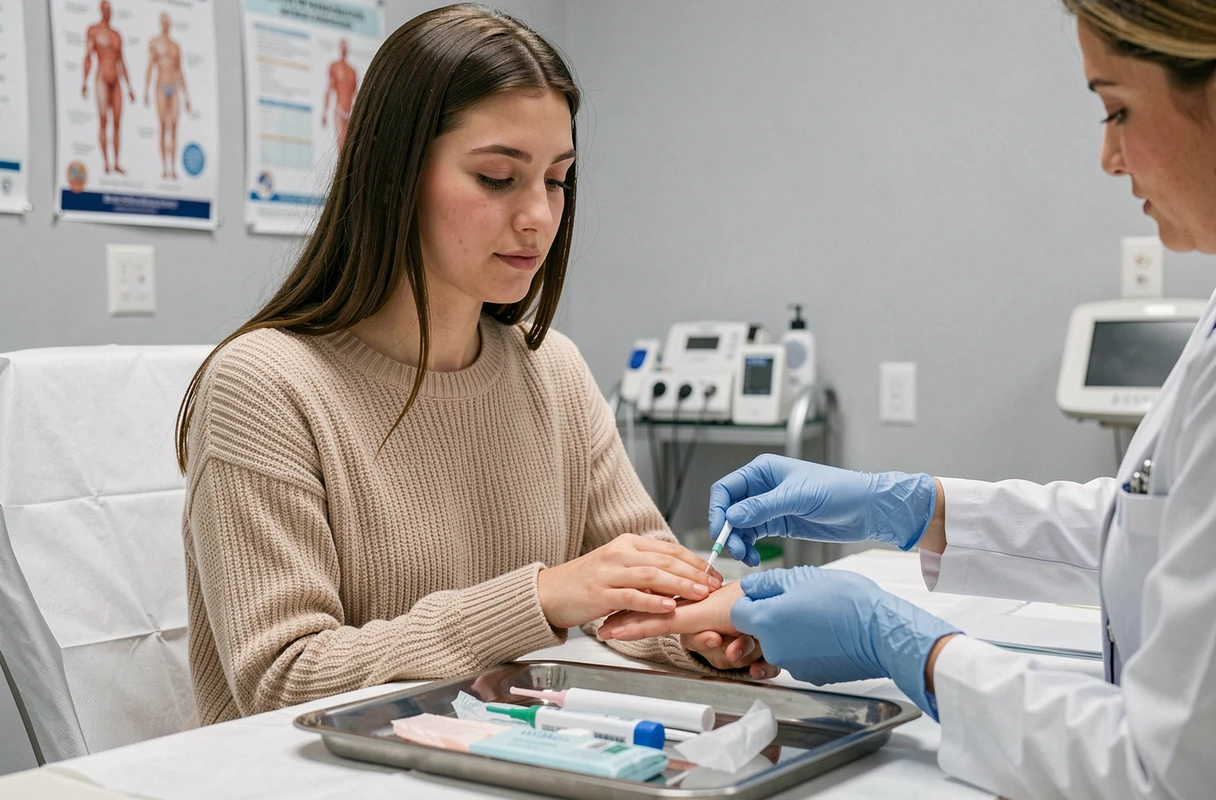
A consultation with a doctor is necessary as soon as any of these signs appear. It is also imperative immediately if the trauma has affected the nail matrix (visible damaged base, heavy bleeding, finger deformation) or if the tetanus vaccination is not up to date.
Nail regrowth after tearing: duration and factors
Healing of the nail bed takes a few weeks, but complete nail regrowth spans several months. A fingernail takes about six months to fully regrow, while a toenail, especially the big toe, may require a significantly longer duration.
Several factors modulate this duration: the condition of the nail matrix after the trauma, the quality of local care during the healing phase, the patient’s age, and their overall health. A properly protected nail bed maintained in a moist environment (petroleum jelly, suitable dressing) offers the best conditions for regular regrowth without deformation.
The follow-up during the first weeks determines the quality of the nail that will regrow. Rigorous daily care during the healing phase influences the texture and strength of the final nail. Any abnormal regrowth (thickened, ridged, detached nail) after several months warrants a medical opinion to check the integrity of the matrix.