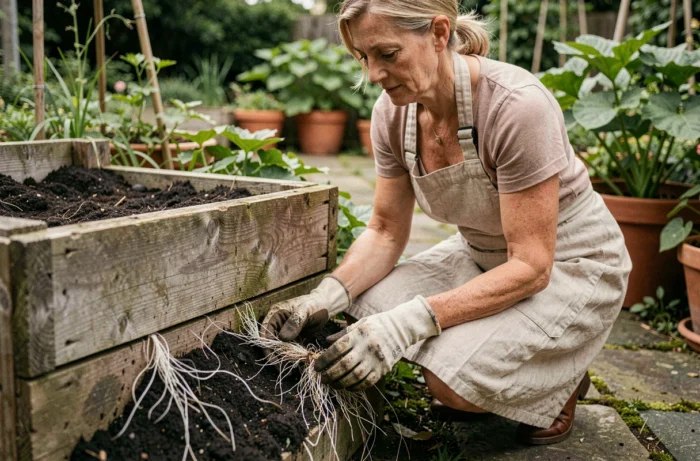
You open your composter after a few weeks away and discover a network of white roots traversing the decomposing material. The pile is colonized, the compost structure compacted, and the earthworms less active. This scenario often occurs when the bin is placed directly on the ground, near hungry trees or hedges. Understanding why roots migrate to the compost allows you to take action before the quality of the finished product deteriorates.
Why roots migrate to the compost
Roots explore the soil by following moisture and nutrients. A composter placed directly on the ground creates an ideal environment for them: warmth, rich organic matter, and loose substrate. The longer the compost stays moist, the more it sends an attractive chemical signal to neighboring root systems.
Invasive species pose a particular problem. Bamboo, ivy, brambles, and some fruit trees develop lateral roots capable of traveling several meters. Even a tree located at a good distance can project its roots well beyond the crown of its branches. If your composter is within this radius, it becomes a primary target.
A waterlogged compost attracts roots faster than aerated compost. Excess water promotes both root exploration and anaerobic fermentation, which degrades the quality of the compost. Covering the pile and controlling moisture thus reduces both problems simultaneously. When discussing too much compost in the vegetable garden on Info Jardinage, it is often this interaction between moisture and roots that is to blame.
Composter base: elevate or insulate the bottom
The first line of defense is under the bin. A composter placed directly on the ground leaves the way open for roots. Two approaches work well.
Elevate the bin on a draining base
Placing the composter on a layer of coarse gravel or bricks creates a physical barrier. Roots have difficulty progressing in a mineral environment without organic matter. The secondary advantage is drainage: excess water flows away instead of stagnating at the bottom of the pile.
Install a semi-permeable bottom
A thick geotextile fabric placed under the bin blocks roots while allowing air and water to pass through. This compromise preserves contact with the soil, enabling microorganisms and worms to colonize the compost from above. A fine mesh wire combined with geotextile provides the best barrier against thick roots as well as root hairs.
- Coarse gravel with a sufficient thickness to discourage roots, then geotextile on top before placing the bin
- Raised wooden pallet, creating an air gap between the ground and the decomposing material
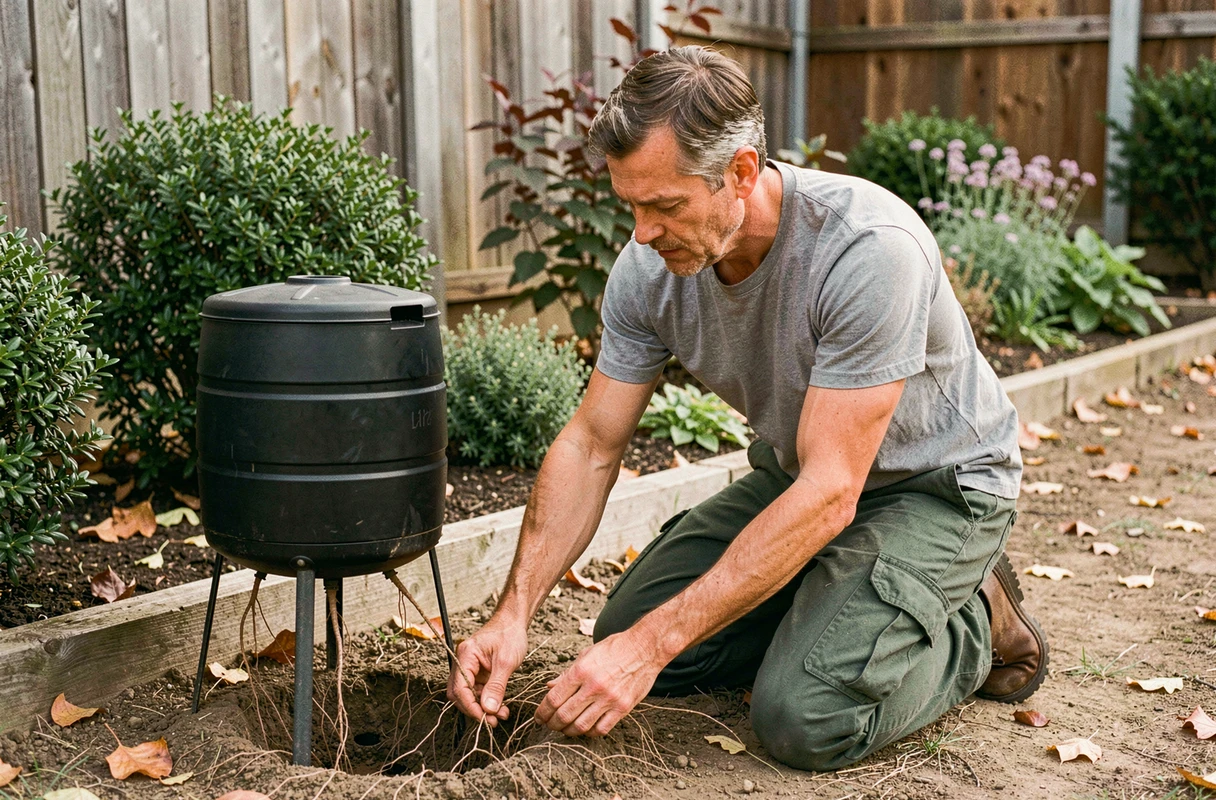
- Compost bin on legs or a rotating model, which eliminates any direct contact with the ground
Compost management to discourage rooting
You may have noticed that some composts remain soft and crumbly while others turn into compact blocks? The internal structure of the pile plays a direct role in the establishment of roots.
Coarse woody materials make the environment less welcoming for roots. Chopped branches, wood chips, and thick cardboard pieces create air pockets. Aerated compost dries faster on the surface, reducing attraction for root systems. Regular alternation between brown materials (carbon) and green materials (nitrogen) maintains this open structure.
Frequent turning also breaks young roots trying to settle in. With each mixing, root hairs are torn and reintegrated as organic matter. Compost turned every two to three weeks remains hostile to rooting.
Another often overlooked point: never compost live roots of invasive plants. Bamboo, bindweed, couch grass—these plants can regrow from a fragment of root in warm compost. It is better to dry them completely in the sun for several weeks before adding them, or dispose of them at the waste disposal site.
Composter location and distance from trees
The choice of location is the most effective and least expensive decision. A composter installed far from trees, hedges, and bamboo will almost never have root problems.
The roots of a mature tree can extend a distance equivalent to twice the length of its longest branches. This radius is often underestimated. An oak or lime tree with a crown several meters wide projects its roots much farther than one might imagine by looking at the trunk.
- Prefer an open area, away from any woody planting
- Avoid the edges of persistent hedges (thuja, laurel, privet) whose superficial roots quickly colonize the fertile layer
- If space is limited, opt for an elevated or rotating composter that eliminates the problem at the source
Placing the composter in a partially shaded area but away from trees is the best compromise. Shade limits evaporation, while distance prevents root intrusion.
Infested compost: what to do when roots are already there
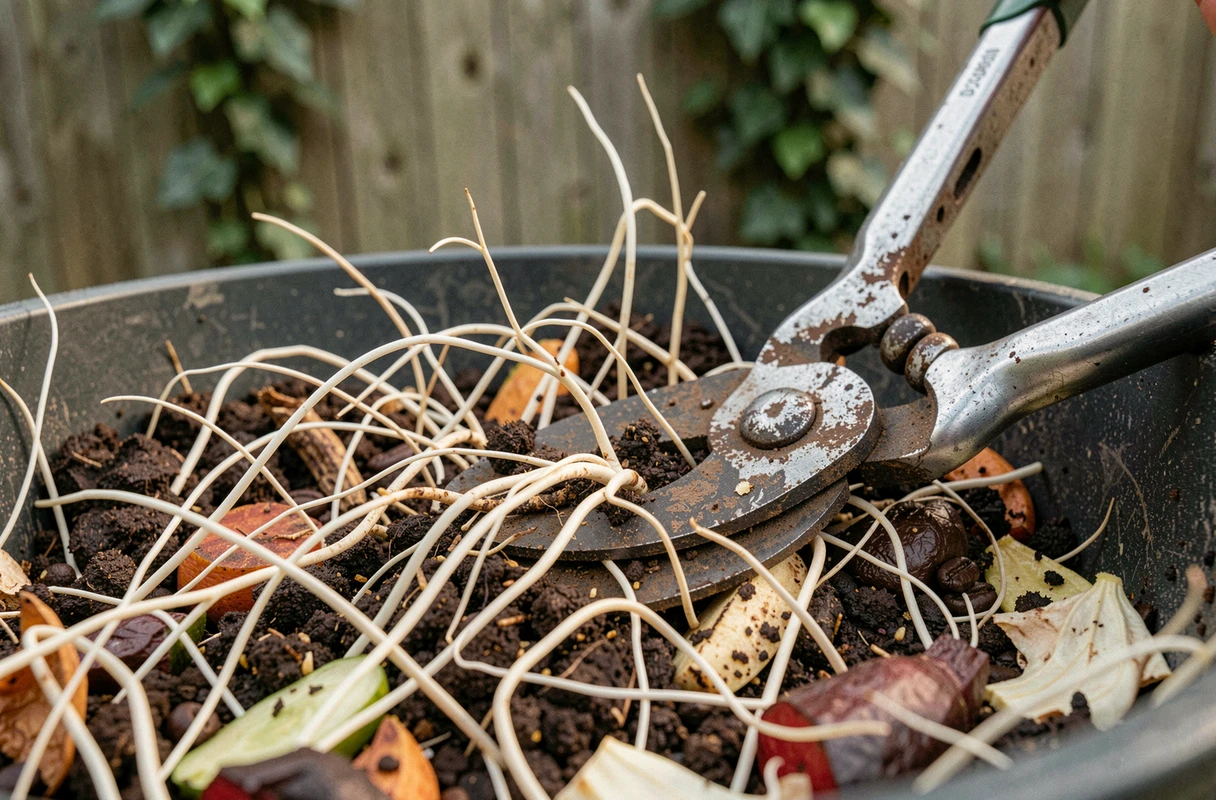
If the damage is done, start by manually removing visible roots during the next turning. Separate the mature compost from the fresh compost. The mature compost, already well decomposed, can be used normally even if it contained dead roots.
For compost still in the process of maturation, move it to a new bin or onto a tarp, taking the opportunity to install a barrier under the bottom. A simple move of the bin a few meters may be enough if the initial area was within the exploration radius of a tree.
Cleanly cut the roots that protrude from the ground at the location of the old bin. They will dry naturally without harming the tree, provided that you do not cut through the main roots of large diameter.
The quality of compost depends as much on what you put in it as on where you place it. A well-positioned bin, slightly elevated and regularly turned, produces a rich amendment without giving roots the time to settle in. The most cost-effective action often remains the simplest: moving the composter away from trees before even seeking a technical solution.