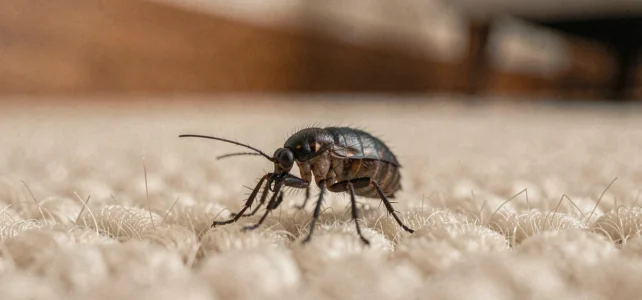
A black insect jumps on the bathroom tiles, another disappears between the floorboards. This scene has been repeating for a few days, always in the same rooms. Precisely identifying these little black creatures that jump in the house is the prerequisite for any action, because treatments differ radically depending on the species involved.
Indoor humidity and proliferation: the factor that treatments do not address
The majority of the small jumping black insects reported in French homes are springtails. Their presence does not indicate a lack of cleanliness, but a persistent excess of humidity.
Recent field reports show that springtails appear in large numbers when indoor humidity exceeds 60% for an extended period, particularly after prolonged rainy spells. Rooms without mechanical ventilation (VMC), basements, garages, and bathrooms without windows are the first to be affected.
Spraying an insecticide in a bathroom where the air stagnates does not eliminate the cause. Condensed water on joints, poorly insulated pipes, and micro-leaks maintain the cycle. As long as the source of humidity remains active, springtails will return.
When you repeatedly spot the black jumping insects in the house in the same damp areas, it is the building that needs to be treated before the insects.
Springtails, fleas, thrips: quick distinction criteria
Three species account for almost all reports of small jumping black insects indoors. Confusing them leads to unnecessary, even counterproductive treatments.
Location and behavior
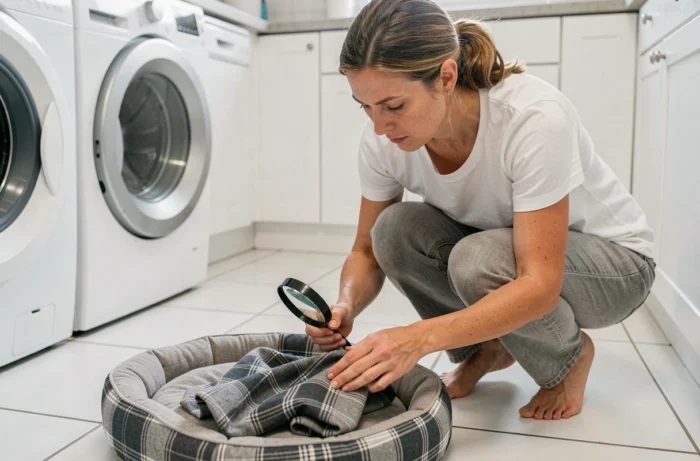
The observation location is the first reliable filter. A springtail is found near a source of moisture (shower tray, plant pot, basement). A flea appears on textiles, carpets, or near a pet. Thrips, rarer indoors, concentrate around houseplants or on window sills.
Bites or absence of bites
Springtails do not bite. If you notice itching or small red marks aligned on the ankles, look towards fleas. Thrips can cause slight skin irritation, but without a visible trace comparable to that of a flea.
Sorting grid in three questions
- Is there a pet in the household and are the bites concentrated on the legs? Likely flea infestation, to be treated on the animal and in the textile environment.
- Do the insects appear exclusively in damp areas (bathroom, kitchen, basement) without any bites? Springtails, to be treated by reducing humidity.
- Are the insects visible on the leaves of houseplants and measure less than two millimeters? Thrips, to be treated by rinsing the leaves and possibly using insecticidal soap.
Targeted dehumidification: the passive pest control method
Insecticides, sticky traps, or white vinegar eliminate visible individuals, but do not change the conditions that attract springtails.
A dehumidifier installed in the critical room significantly reduces springtail intrusions, provided it is coupled with regular ventilation. The goal is to bring humidity below 55% in the affected areas.
Complementary actions to be carried out in parallel:
- Check the sealing of bathroom and kitchen joints, replacing those that are blackened or detached.
- Control the saucers of houseplants, where stagnant water provides an ideal habitat for springtails.
- Ensure sufficient ventilation in windowless rooms: a functional VMC or, failing that, a mechanical extractor fan.
- Remove stored wood indoors (logs, pallets), which retains moisture and often harbors colonies.
For fleas, the approach is different. The treatment first involves the animal (veterinary antiparasitic), followed by a high-temperature wash of textiles and a thorough vacuuming of floors and corners. Treating the home without treating the animal does not stop the flea reproduction cycle.
Decent housing obligation and pests: what French law says
Since the ELAN law of 2018, supplemented by the “Degraded Habitat” law of July 27, 2023, the definition of decent housing explicitly includes the absence of infestation by pests and parasites. This criterion is concretely mobilized during rental disputes.
For a tenant facing a persistent infestation of fleas or springtails related to a defect in the building (infiltrations, lack of ventilation), the landlord is obliged to bring the housing into compliance. The available data do not allow for a conclusion on the exact sharing of costs in each situation, as case law distinguishes structural causes (the landlord’s responsibility) from usage-related causes (the tenant’s responsibility).
In case of doubt, a bailiff’s report or a humidity diagnosis carried out by a professional can document the origin of the problem before any formal notice.
The repeated presence of small jumping black insects in a dwelling is therefore not just a domestic inconvenience. It is a warning signal about the hygrometric state of the building, and sometimes a legal lever to demand repairs. A hygrometry reading in the affected rooms and a precise identification of the species directly guide towards the appropriate treatment, whether technical or legal.