
The online market for baby products has significantly expanded in recent years. Between general marketplaces, specialized shops, and third-party resellers, parents are faced with a plethora of options where quality coexists with non-compliant products. Two recent regulatory developments redefine the vigilance criteria when making an online purchase, and knowing them concretely changes the way to filter product listings.
R129 Standard and GPSR Regulation: What Has Changed for Online Purchases
As of September 1, 2024, only car seats compliant with the UN R129 (i-Size) standard can be sold new in the European Union. Older models approved under R44/04 are no longer permitted for sale. On an online product listing, this is verified by the presence of an orange type E approval label indicating a size range (and no longer just a weight).
This distinction may seem technical, but it has a direct consequence: a seat sold by a third-party reseller on a marketplace may still display an old R44/04 approval, especially if it comes from a stock outside the EU. The absence of R129 mention in photos or descriptions is a warning sign that should not be ignored.
The second change concerns all baby products. The (EU) 2023/988 regulation on general product safety (GPSR), fully applicable since December 13, 2024, requires online sellers to display accessible technical documentation and a clearly identified point of contact for the manufacturer in Europe. Bottles, pacifiers, bouncers, high chairs, strollers: all are affected.
For parents, browsing baby accessories on Maman Bébés allows them to familiarize themselves with the most common product categories and identify the expected information on a compliant listing.
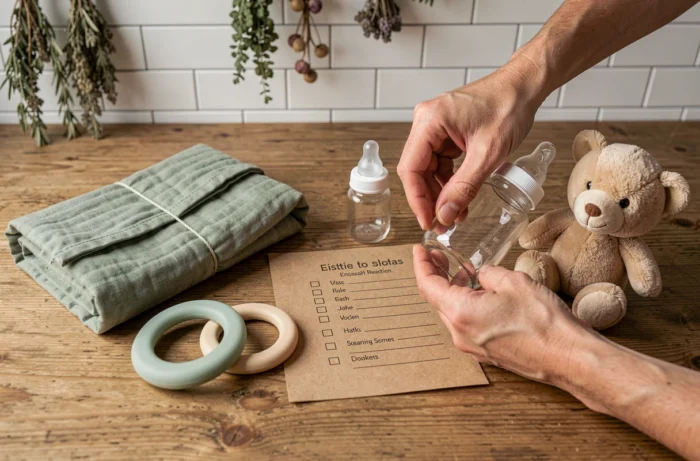
Online Product Listing: Concrete Elements to Check Before Adding to Cart
Regulatory compliance can be read on the product listing itself. Three elements allow you to distinguish a reliable item from a questionable product.
- The CE marking and the applicable standard (EN 1888 for strollers, EN 716 for cribs, UN R129 for car seats) must be included in the description or on the product photos. Their absence is not a trivial oversight.
- The name and address of a manufacturer or importer based in the European Union must be indicated. The GPSR makes this mention mandatory. A product sold without this information does not meet current requirements.
- User reviews mentioning recurring manufacturing defects (seams coming apart, small detachable parts, faulty locking mechanisms) deserve careful reading. A recent product recall involved a baby chair sold at Leclerc and Amazon, which could tip over and cause serious injuries.
Field returns differ on the reliability of product photos: some online shops use generic visuals that do not exactly match the model shipped. Comparing the photos on the listing with those published by buyers remains a useful reflex.
Baby Toiletries and Body Products: Reading Beyond Marketing
Wipes, cleansing gel, body lotion, and sunscreen for babies represent a significant portion of online baby product purchases. The choice often relies on packaging and mentions like “hypoallergenic” or “dermatologically tested,” which do not have a strict regulatory definition.
The INCI composition remains the only objective indicator for evaluating a toiletry product intended for babies. It must be fully visible on the online listing, not just summarized by pictograms. A product whose ingredient list does not appear on the page deserves to be discarded.
For sunscreen products intended for children, the mention of the protection factor and compliance with European cosmetics regulations are verifiable criteria. The available data does not allow us to conclude that a product sold exclusively online presents more risks than a product purchased at a pharmacy, but the absence of personalized advice online requires a more attentive reading of compositions.

Product Recalls and Warning Signals on Marketplaces
The RappelConso database, managed by French authorities, lists products withdrawn from the market or recalled for safety defects. Recent recalls include non-compliant latex pacifiers and baby food with anomalies.
On marketplaces, a recalled product may remain on sale by a third-party seller for several days after the official notification. The GPSR regulation now requires platforms to actively cooperate with supervisory authorities, but the actual withdrawal times vary.
Some reflexes can limit this risk:
- Check RappelConso before making a baby product purchase, filtering by the category “products intended for children”
- Prefer sellers whose after-sales service is based in Europe, which facilitates handling a potential recall
- Verify that the product has not been marketed under a different brand name in another country, which complicates tracking alerts
Limits of Online Comparisons and Parent Reviews
Community review platforms gather hundreds of thousands of feedback from parents. These reviews provide concrete information about the durability, comfort, or practicality of an accessory in daily use. However, a positive review does not guarantee the regulatory compliance of a product.
Editorial comparisons present another limitation: they rarely test products over time. A bouncer may seem satisfactory upon receipt and exhibit a mechanical defect after a few weeks of use. Feedback published several months after purchase is often more informative than first impressions.
The intersection of regulatory verification (marking, standards, manufacturer identification) and long-term usage feedback constitutes the most reliable method for choosing baby accessories online. Neither of these two sources, taken in isolation, is sufficient to guarantee a safe purchase.