On a sloped terrain with brambles overflowing along a low wall, a corded electric trimmer quickly shows its limitations. The cable gets stuck, the power is lacking, and you end up using shears to cut what the machine couldn’t. It’s precisely in these situations that a gas trimmer becomes invaluable: no cord to trip over, a motor capable of tackling dense vegetation, and autonomy that depends solely on the fuel tank.
Legal risk related to the noise of a gas trimmer
Before even discussing engine displacement or cutting width, we must address a point that most buying guides overlook. Since Law No. 2024-346 of April 15, 2024, abnormal neighborhood disturbance is included in the Civil Code under Article 1253. The liability is said to be “strict”: a neighbor can be held liable even without proven fault, as long as the noise is deemed excessive in duration, repetition, or intensity.
The criterion set by the regulations is sound emergence, which is the difference between the noise level with the device running and the residual ambient noise. The thresholds are set at 5 dB(A) during the day and 3 dB(A) at night. A gas trimmer in operation easily exceeds these thresholds in a quiet neighborhood.
Since October 1, 2023, the offense related to noisy equipment in private homes has been reclassified as a 4th class misdemeanor. The fine can now reach 750 euros in front of the police court. We compare models and brands below, but keeping this constraint in mind already guides the choice: prioritize a quieter motor, strictly adhere to municipal hours, and check the municipal decree of your town.
Engine displacement and power: what really matters on the ground
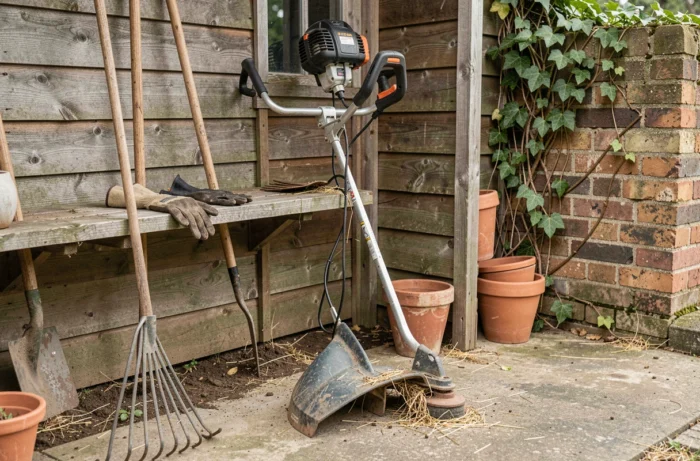
On coupebordurethermique.fr, you can find detailed sheets that allow you to compare engines before purchase. The displacement of a gas trimmer directly determines its ability to cut through thick vegetation without stalling.
For soft grass along a path, a small displacement is sufficient. However, if you’re tackling tall grasses, thick nettles, or woody regrowth along a hedge, you need to increase power. Feedback on this point varies depending on the state of the terrain, but the rule remains simple: an undersized motor strains, overheats, and wears out prematurely.
Two-stroke or four-stroke engine
The majority of consumer gas trimmers are equipped with a two-stroke engine. It is lighter, more responsive at startup, but requires a fuel-oil mix. The four-stroke consumes less, runs more smoothly, and produces less vibration. However, it is noticeably heavier, which is felt during extended sessions.
The choice depends on the use. For a medium-sized garden with borders to maintain every two weeks, the two-stroke remains the standard. For larger areas or near-professional use, the four-stroke deserves consideration.
Cutting head and nylon line: adapting the tool to the type of vegetation
The cutting head is the part that does the work. There are three main systems:
- The semi-automatic nylon line head, the most common. You tap the head on the ground to release more line. Suitable for soft grass and finishing touches along flower beds.
- The automatic nylon line head, which dispenses line continuously without intervention. More convenient, but line consumption increases.
- The plastic or metal blade head, reserved for tough vegetation. This moves you into an intermediate zone between a trimmer and a brush cutter.
The diameter of the nylon line plays a direct role in cutting capacity. A thin line is suitable for soft grasses. A thicker line attacks resistant stems without breaking every thirty seconds. Choosing the right line diameter avoids half of the frustrations on the ground.
Cutting width and maneuverability
A generous cutting width saves time on long border lengths. Conversely, you lose precision in tight angles, around fence posts, or between the stones of a low wall. For a garden with many corners, a moderate cutting width remains more practical on a daily basis.

Ergonomics and weight of the gas trimmer: don’t neglect comfort
A gas trimmer weighs significantly more than a battery or corded model. Since you hold it at arm’s length, sometimes for an hour, two elements make a difference:
- The harness or shoulder strap. On entry-level models, a simple flat strap barely suffices. A harness distributes the weight across both shoulders and the hips, which radically changes comfort during long sessions.
- The handlebar or D-handle. The double handlebar offers better lateral control for large flat areas. The D-handle allows for more precise movements in tight spaces.
- The straight or curved drive shaft. The curved shaft brings the cutting head closer to the ground without bending over, but the straight shaft transmits power better on high-displacement models.
Testing the grip before buying remains the most concrete advice we can give. The weight on the technical sheet doesn’t tell the whole story: the weight distribution and balance of the machine are just as important as the raw number.
Regular maintenance of a gas trimmer
A gas engine requires regular maintenance. Spark plug, air filter, quality of the mix for two-strokes: neglecting these points guarantees difficult starts at the beginning of the season. Draining the fuel at the end of the season and storing the machine in a dry place extends its lifespan by several years.
The nylon line is easily replaceable, but storing a spare spool in the workshop avoids interrupting the session at the wrong moment. For blade heads, checking the condition of the blades after each intensive use prevents unwanted vibrations that fatigue both the engine and the user.
The gas trimmer remains a powerful tool for gardens where freedom of movement and cutting power are paramount. The regulatory constraint on noise pushes you to choose a model suitable for your environment, not just your terrain. A good compromise between displacement, weight, and noise level provides a tool that you can use without apprehension, season after season.