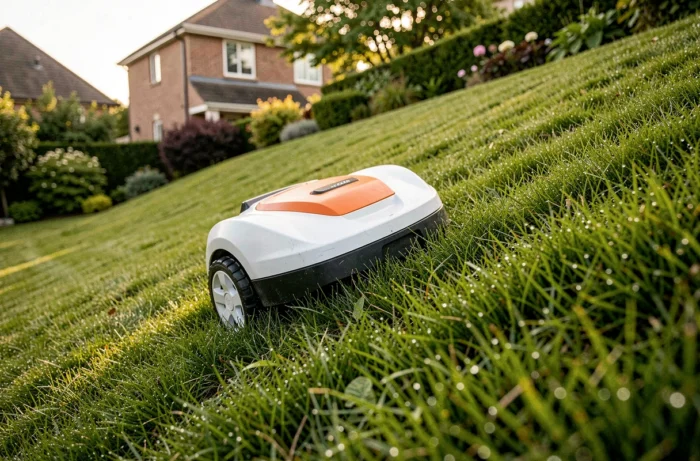
Choosing a robotic mower for a steep slope is not just about comparing a maximum slope figure on a technical sheet. The value stated by the manufacturer almost always corresponds to a straight ascent on dry grass, without turns. The actual conditions of a sloped garden (camber, wet grass, turns near the edge) reduce this capability by several points. It is this gap between manufacturer data and real-world performance that needs to be measured before any purchase.
Stated slope and actual slope: the gap that technical sheets do not show
Recent comparisons converge on one point: the maximum slope indicated by a manufacturer should be reduced by 5 to 8 percentage points to reflect the robot’s actual capacity. A model advertised for 45% slope will not necessarily hold at 45% under normal conditions.
The reason lies in the measurement protocol. Manufacturer tests are conducted on a regular, short slope, with closely mowed and dry grass. In a garden, the robot must also turn on a camber, follow an inclined edge, and restart after stopping on a slope. These maneuvers demand more grip and traction than simple linear ascent.
Several 2026 guides emphasize this criterion: the ability to turn and hold on a camber near edges matters more than the raw maximum slope. Before comparing models, it is essential to measure the steepest part of the terrain with an inclinometer or a smartphone app, placing the device on a rigid board of at least one meter to avoid skewing the reading.
Field feedback also shows that finding the best robotic mower for steep slopes requires cross-referencing this measurement with soil condition, the presence of roots, and the usual moisture level of the lawn.
AWD robotic mower or two-wheel drive: comparison on sloped terrain
All-wheel drive (AWD) is often presented as essential for steep slopes. Field data nuances this claim.
| Criterion | 2-Wheel Drive Robot | AWD Robot (4-Wheel Drive) |
|---|---|---|
| Stated maximum slope (typical) | Up to 35-40% | Up to 70-80% |
| Usable actual slope (after correction) | About 30-35% | About 60-70% |
| Stability on camber and turning | Limited beyond 25-30% | Stable even on steep turns |
| Performance on wet grass | Frequent slipping from moderate slope | Significantly better grip |
| Acquisition cost | Entry/mid-range segment | High-end segment |
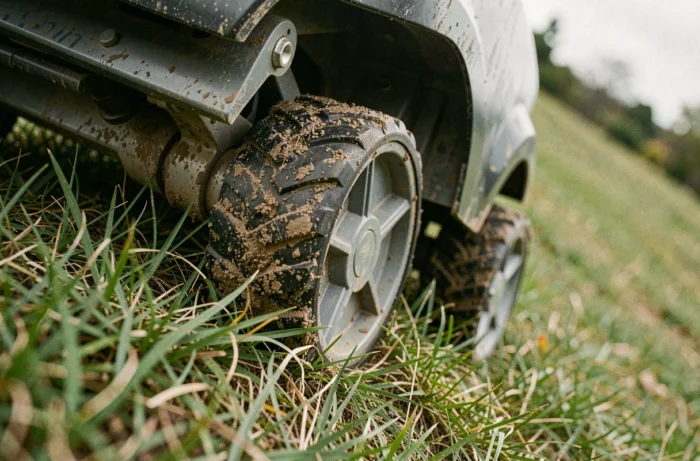
For gardens where the steepest slope remains below 25-30%, a two-wheel drive robot equipped with knobby tires and good software management of edges may suffice. Beyond 30% actual slope, all-wheel drive becomes a determining factor to avoid slipping and repeated returns to the station.
However, on moderately sloped but uneven terrain (roots, bumps, narrow passages), it is the combination of a raised chassis and wide wheels that makes the difference, not just the all-wheel drive.
Wireless navigation and management of sloped areas: GPS-RTK, cameras, and LiDAR
The type of navigation directly influences the robot’s behavior on a steep slope. Three technologies coexist in the 2026 market.
- GPS-RTK: centimeter-level positioning that allows the robot to follow regular parallel trajectories. On sloped terrain, this avoids random passages that multiply unnecessary ascents and strain the battery.
- Onboard cameras (computer vision): real-time obstacle detection, useful in wooded areas where the satellite signal may be degraded. Some recent models combine four cameras to cover a wide field.
- LiDAR: three-dimensional mapping of the terrain that improves navigation in narrow passages and shaded areas. Coupled with RTK, it offers the best positioning accuracy available.
On sloped terrain with trees and obstacles, the combination of RTK and onboard vision reduces unnecessary trips and preserves battery autonomy. A robot that ascends and descends in an orderly manner consumes less than a model with a random trajectory on the same elevation change.
Cable-free installation on sloped terrain
Wireless robots (navigation via RTK, cameras, or LiDAR) eliminate a major constraint on slopes: the buried cable. On uneven terrain, installing a cable along the edge of a sloped area is tedious, and the wire can shift with soil movement.
Cable-free models delineate mowing areas through virtual mapping via a smartphone app. This approach also allows for defining exclusion zones around a flowerbed or tree without physical intervention, simplifying the management of a complex garden.
Decisive technical criteria for a robotic mower on steep slopes
Beyond traction and navigation, three technical parameters separate a robot that can handle slopes from one that slips or loses grip.
- Tires and tread: wide tires with deep treads increase the contact surface and grip. On wet grass, this criterion weighs as much as the type of transmission.
- Center of gravity and weight: a heavier robot with a low center of gravity stays better on the ground on a camber. Lightweight models designed for flat terrain tip or slide sideways as soon as the incline exceeds their threshold.
- Motor power and electronic management: a high torque motor on each wheel prevents slipping when resuming ascent. Electronic management adjusts power wheel by wheel to compensate for a camber.
The new European regulation on machines (EU Regulation 2023/1230), which is currently undergoing regulatory transition, will impose stricter safety requirements on manufacturers. Robotic mowers will need to align with this framework, which should standardize certain levels of performance and safety on slopes.
Choosing a robot for steep slopes, therefore, relies less on a single figure and more on the intersection of several measurable data: actual slope inclination, soil type, presence of camber, and compatibility between traction, navigation, and tire profile. It is this combination that determines whether the robot will hold up over time, not just the maximum slope value displayed on the box.