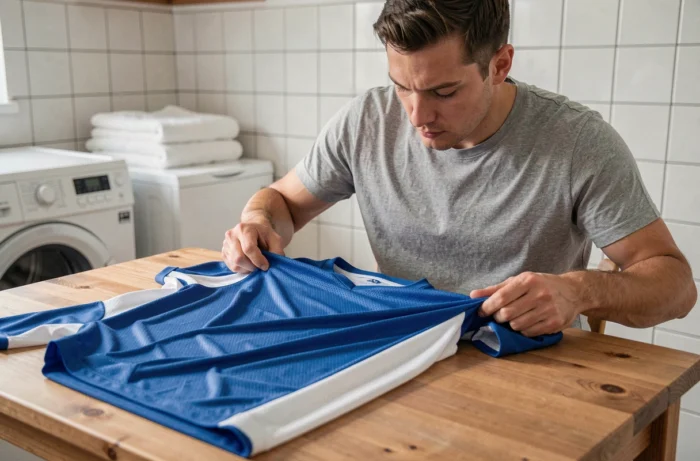
Enlarging a football jersey without damaging it requires understanding what you are handling: a synthetic textile, most often polyester or a polyester-elastane blend, onto which flocking, heat-sealed badges, and sublimated prints are applied. Each stretching method affects these components differently, and some can destroy the decoration long before gaining a centimeter in chest circumference.
Flocking and prints: the constraint that no one addresses first
Most guides on enlarging a football jersey focus on the fabric. The real limiting factor is the decorations. The numbers, logos, and player names are fixed by heat transfer or direct sublimation into the fiber.
Any technique that involves heat (iron, dryer, steam) weakens these elements even before softening the polyester. Repeated mechanical friction, combined with an aggressive detergent, accelerates cracking and peeling of the prints.
If your jersey has a flocking that you care about, prioritize methods without heat or mechanical friction. Cold approaches, such as soaking and manual stretching, preserve the integrity of the decorations much better. To explore in detail the techniques for enlarging a football jersey, sewing remains a complementary option that avoids any thermal stress on the fabric.
Cold stretching of a polyester jersey: method and limits
Polyester is a thermoplastic fiber. At room temperature, its molecular chains resist deformation. Therefore, cold stretching does not permanently alter the fabric’s structure: the jersey partially returns to its original shape after a few washes.
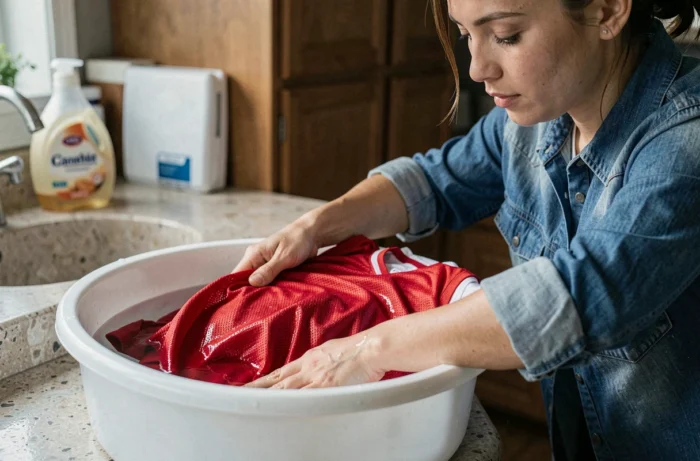
The most common method involves soaking the jersey in warm (not hot) water mixed with a fabric softener, then gently stretching it by hand in the desired direction. It is then left to dry flat, held in tension by light weights placed on the edges.
- Soak the jersey for about twenty minutes in warm water with a dose of fabric softener, which temporarily relaxes the tension between the fibers.
- Gently wring out without twisting, then gradually stretch the fabric in width or length, as needed. Work with small, regular pulls rather than a sharp tug.
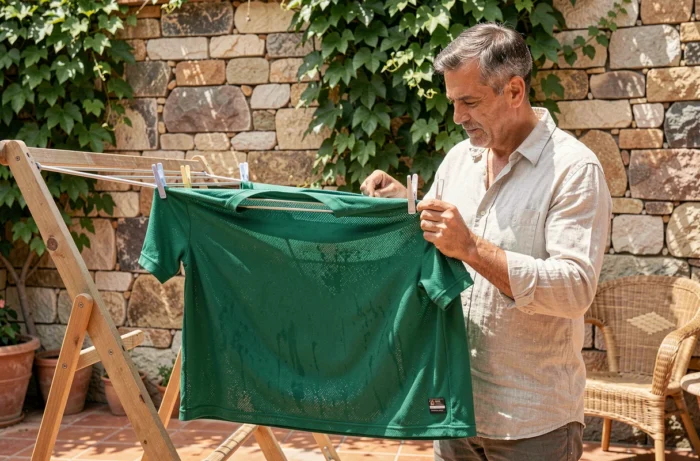
- Lay the jersey flat on a clean towel, pin or weigh down the edges to maintain the shape achieved, and let it dry away from any direct heat source.
The gain rarely exceeds half a size. Beyond that, the fabric loses its elasticity, and the visual appearance deteriorates, with stitches distorting unevenly.
Heat and dryer: why the risk often outweighs the benefit
Some online advice suggests using a high-temperature dryer to soften polyester. Field reports vary on this point, as the result is very inconsistent from one jersey to another.
What is documented, however, is that polyester does not react well to prolonged high temperatures. Excessive heat drying can permanently deform the fabric, creating wavy or puckered areas that are impossible to correct. On a polyester-elastane blend jersey, the elastane fiber degrades faster than the polyester, leading to localized loss of elasticity.
The iron poses a similar problem. Even when interspersing a damp cloth, concentrated heat damages heat-sealed transfers. A flocking that cracks after ironing is irrecoverable.
When heat is justified nonetheless
On a jersey without flocking, made of pure polyester, without sublimated prints, a short stint in the dryer at moderate temperature can help relax the fibers before manual stretching. The key word is “moderate”: the temperature should not exceed that of a delicate cycle.
Sewing alteration: the only durable enlargement method
All home stretching methods share the same limitation: they are temporary. Polyester has a memory effect. After a few washes, the jersey tends to revert to its original size.
For a lasting enlargement, sewing alteration remains the only reliable option. The principle is to add material, either by inserting fabric strips into the side seams or by replacing the underarm panels with wider ones.
This approach requires a minimum of sewing skills. Points to watch out for:
- Choose an insertion fabric compatible with the jersey’s polyester (same weight, same elasticity), or risk creating wrinkles or distortions at the junctions.
- Use polyester thread, not cotton thread, to maintain the elasticity of the seams.
- Work on the side seams and under the sleeves, which offer the most margin without altering the position of the central flocking.
- Avoid touching the shoulder seams, as they determine the overall drape of the jersey. Altering them shifts the position of the sleeves and distorts the silhouette.
Polyester-elastane and recent jerseys: a fabric more difficult to enlarge
Recent football jerseys incorporate an increasing proportion of elastane to improve comfort and support. This blend makes the fabric naturally stretchy but also more resistant to permanent deformation.
A stretch jersey returns to its original shape faster than a pure polyester jersey. Soaking stretching methods yield even more ephemeral results on these textiles. Sewing alteration remains the most realistic way to gain a full size.
Moreover, polyester-elastane blends pose a problem at the end of their life: these combined fibers are difficult to separate for recycling. If you are hesitating between enlarging a jersey or buying a new one, extending the lifespan of the one you already own has a concrete environmental impact.
Ultimately, the choice of method depends on what you are willing to risk. A cold soak followed by manual stretching offers modest gains without damage. Sewing provides a permanent result, at the cost of a little technique. Heat remains the least predictable option, especially on a flocked jersey.