Compacting gravel involves reducing the volume of voids between the aggregates to achieve a dense, stable layer capable of supporting loads without deforming. This operation relies on three interrelated parameters: the grain size of the material, its moisture content, and the mechanical energy applied. If not done correctly, it can lead to delayed settlements, ruts, or infiltrations that compromise the lifespan of the structure.
Load-bearing capacity and Proctor test: measurable objectives of gravel compaction
Most online guides advise to “compact the gravel well” without ever specifying what constitutes an acceptable result. Earthmoving professionals think differently: they set a minimum load-bearing capacity measured in MPa before laying a surface or considering the layer complete.
For light traffic (pedestrian paths, garage access), the target is around 30 MPa. For a parking lot or a road subjected to regular heavy vehicle traffic, the target rises to 50 MPa. This value is verified through a plate test directly on site.
The Proctor test, conducted in a laboratory, determines the maximum dry density of a material and the optimal moisture content to achieve it. On site, the density obtained after compaction is compared to this reference. A good result is generally above 95% of the Proctor density. Finding tips for well-compacted gravel helps to understand this logic, but grasping the principle is already a decisive step: without a quantified load-bearing objective, compaction remains approximate.
Layer thickness and optimal moisture for compacting gravel
Working in layers is a well-known principle. What is less known is the thickness limit beyond which the energy from the vibrating plate or roller does not penetrate deeply enough.
Layer thickness according to equipment
A standard construction vibrating plate effectively compacts a layer of gravel about twenty centimeters thick after spreading. Beyond that, the vibration diminishes before reaching the bottom of the layer, leaving a loose area beneath the surface. Heavier vibrating rollers can tolerate greater thicknesses, but the principle remains the same: it is better to have two well-compacted layers than one overly thick layer.
Each layer must be leveled with a rake or a straightedge before compaction. Uneven spreading creates local over-thicknesses that escape vibration and form weak points.
The role of moisture in soil compaction
Gravel that is too dry creates high friction between the grains: they do not slide well against each other, and the density remains low. Conversely, overly wet gravel contains free water that prevents the particles from coming together.
A slight moisture content, close to the optimal Proctor moisture, facilitates compaction by lubricating the contacts between aggregates without saturating the voids. On site, this translates to light watering with a hose or sprayer before each pass of the vibrating plate. If the material has been stored outdoors in the rain, it may be necessary to wait for it to dry out before compacting.
Choosing gravel and preparing the ground before compaction
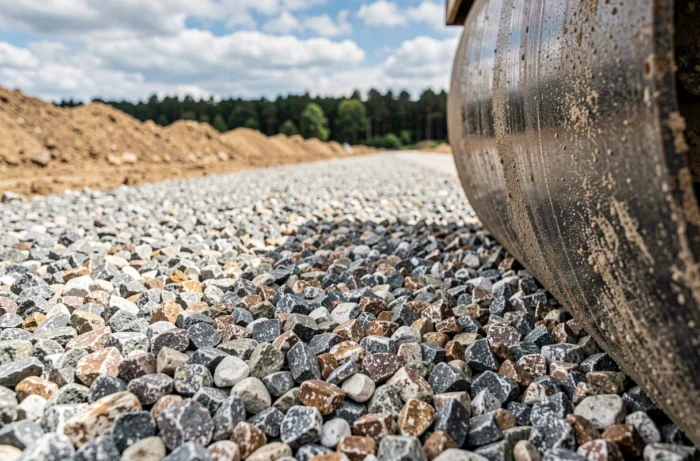
The type of gravel largely determines the final result. Crushed gravel, with sharp and angular edges, interlocks naturally under vibration. Round pebbles, smooth by nature, slide over each other and never form as dense a layer.
For a driveable path, a mix of grain sizes (from fine to medium) produces a more compact granular skeleton than a single size. The fines fill the voids between the larger grains, which increases the overall density.
Preparing the supporting soil
Before laying the first layer of gravel, the existing soil must be stable. Here are the steps to follow:
- Excavate to a sufficient depth to accommodate all planned layers (drainage sub-layer and finishing layer). For a driveable path, an excavation of about thirty centimeters is common.
- Level and compact the subgrade with a manual tamper or vibrating plate to eliminate soft areas. An unstable clayey or silty soil may require prior lime treatment.
- Lay a geotextile fabric on the subgrade to prevent fines from the soil from rising into the gravel, preserving the drainage capacity and load-bearing capacity of the compacted layer.
Vibrating plate, roller, or manual tamper: which compaction equipment to choose
The choice of equipment depends on the area to be treated and the thickness of gravel to be compacted.
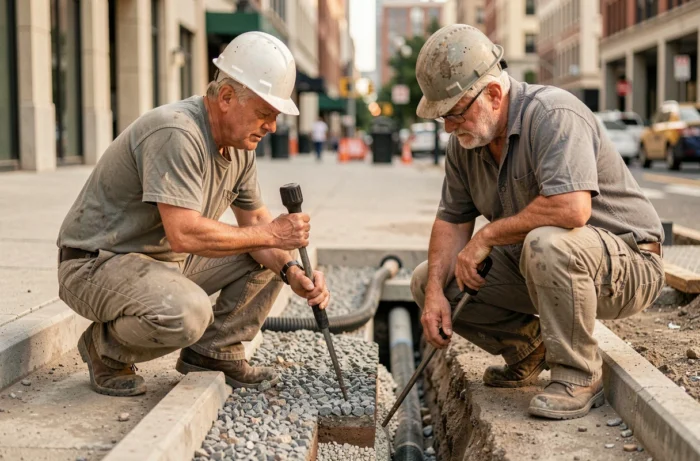
- Manual tamper: suitable for small areas (around a manhole, narrow border). High physical effort, result limited to very thin layers.
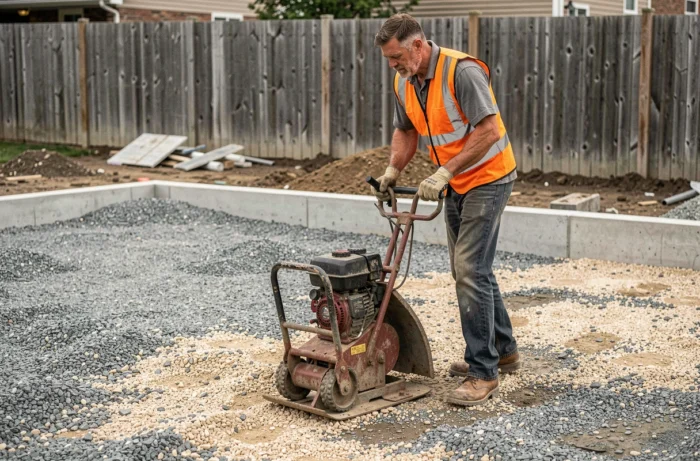
- Vibrating plate: the reference tool for driveways and patios. It combines its own weight with high-frequency vibration that rearranges the grains deeply. Available for rent at most construction equipment rental stores.
- Vibrating roller: reserved for large areas (parking lots, long access roads). Its greater mass allows for compacting thicker layers in fewer passes.
Regardless of the tool, the technique of passing is as important as the power of the machine. Each strip should overlap the previous one by about a third to avoid uncompact areas. Two to three passes per layer are generally sufficient; beyond that, the density gain becomes marginal, and the risk of fracturing the aggregates increases.
Checking the result after gravel compaction
Once the last layer is compacted, a visual check is not always sufficient. The surface may appear firm while a loose pocket remains below.
The plate test mentioned earlier remains the reference method on professional sites. For a homeowner, a simple test consists of walking on the compacted surface: if the foot sinks more than a few millimeters or if footprints remain visible, the density is insufficient, and an additional pass is necessary.
Well-compacted gravel does not move underfoot and does not produce rolling noise when walked on. If loose gravel remains on the surface, a light sweeping followed by a final pass with the vibrating plate resolves the issue. Long-term maintenance is limited to occasionally filling worn areas and checking drainage after heavy rains.