
On a a renovation site, door frames are often ordered at the last minute. The postformed door tops the sales for interiors, but between two similar references on the shelf, the quality gaps during installation are real. Understanding what differentiates one postformed leaf from another avoids unpleasant surprises once the frame is sealed.
Usable passage width of a postformed door: the trap of nominal dimensions
We commonly talk about door frames of 73, 83, or 93 cm. These dimensions refer to the width of the leaf, not the actual passage width once the door is opened to 90°. The difference may seem trivial, but it is not at all in the context of accessibility or for the passage of a wheelchair.
The passage width is measured with the leaf open at 90°, between the face of the leaf and the opposite jamb, not taking the handle into account. The decree of June 25, 1980, provides for a tolerance of 5% on the width of passage units, but accessibility and fire safety regulations require a minimum usable passage width. In practice, an 83 cm door frame does not always provide 83 cm of clear passage.
Before purchasing, check the manufacturer’s technical sheet to know the indicated usable passage width. A postformed leaf with a thick frame or hinges that encroach on the opening may fall below the regulatory threshold. When renovating a home intended to accommodate people with reduced mobility, this verification is not optional. You can also find the selection criteria on Madmoizl Déco that detail these dimensional points well.

Honeycomb or solid core: acoustic comfort and durability
The standard postformed door has a honeycomb cardboard core, wrapped in a melamine or laminated facing. This explains its lightweight and affordable price. However, this type of core offers limited acoustic insulation.
When installing a door between a bedroom and a hallway leading to a living room, the level of acoustic comfort matters. A honeycomb core allows significantly more noise to pass through than a solid core made of particleboard or chipboard. For rooms that require quiet, a solid core significantly improves sound insulation.
The mechanical durability also differs. A honeycomb core door does not withstand repeated impacts well (in apartment hallways, homes with children). The denting of the facing is irreversible. On a solid core, impact resistance is much higher, and the attachment of handles or locks lasts better over time.
Concrete criteria for choosing between honeycomb and solid core
- High traffic areas (entrance, hallway, laundry room): prefer a solid or semi-solid core for impact resistance
- Bedrooms and offices: a solid core provides a real gain in acoustic insulation, noticeable in daily use
- Infrequently used secondary rooms (closet, pantry): the honeycomb core is sufficient and reduces the overall budget
- Rental housing: a solid core withstands rental wear better and limits replacements between two leases
Surface appearance and quality control: what to inspect before installation
A postformed leaf may have surface defects that go unnoticed in the packaging: scratches, decor ripples, small blisters under the facing. Once installed and illuminated by daylight, the result is glaring.
The UICCB has formalized the inspection method for finished door leaves. The examination is done from two meters away, in non-grazing light, with the observer positioned perpendicularly to the door. If the defects are not visible under these conditions, the leaf is deemed compliant. This protocol serves as a reference in case of disputes with a supplier.
In practice, on site, each door is unpacked and inspected before installation. Once screwed into the frame, claiming a surface defect becomes much more complicated. Anomalies are noted, photographed, and reported to the supplier before any implementation.
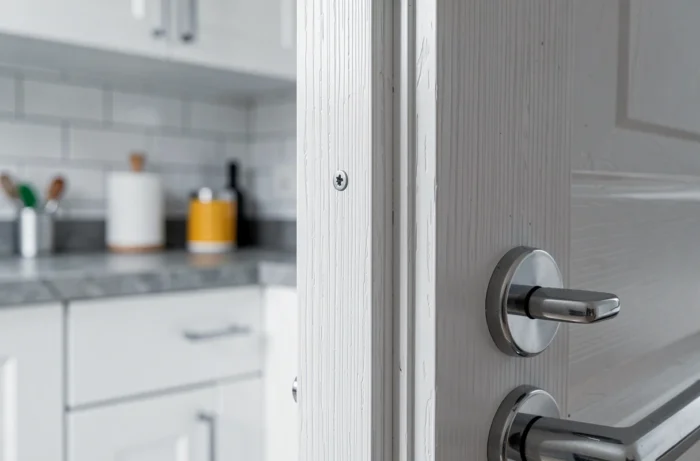
Frame dimensions and cutability: adapting the postformed door to the existing structure
In renovation, the dimensions of openings do not always match standards. One often encounters old partitions with non-standard heights or widths. The question of cutting then arises.
A honeycomb core postformed door can be cut very little. Removing too much material from the bottom of the leaf exposes the honeycomb and weakens the structure. Feedback varies on this point, but beyond a few centimeters, the result is rarely clean. Check the cutting margin indicated by the manufacturer before purchase to avoid ending up with an unusable leaf.
The frame also plays a role. A door frame delivered with its frame is sized for a given wall thickness. If the existing wall is thicker or thinner, it is necessary to either adapt the frame with casing strips or order a custom door frame. Neglecting this verification creates irregular gaps between the leaf and the frame, degrading both aesthetics and insulation.
Measurement points to note before ordering
- Width and height of the bare opening (without trim), measured at three points to detect any out-of-plumb
- Exact thickness of the wall, including finishes (plaster, tiling, paneling)
- Desired opening direction (left or right swing) and available clearance in the room
In small rooms, a pocket sliding door can advantageously replace a swinging postformed door. The space-saving is immediate, and the comfort of use in a narrow bathroom or toilet changes radically.
Ultimately, the choice of a postformed door relies on checks made before ordering, not after. Usable passage width, type of core suitable for the room’s use, visual inspection upon delivery, compatibility with wall thickness: these four points, methodically checked, are sufficient to avoid most problems encountered on site.