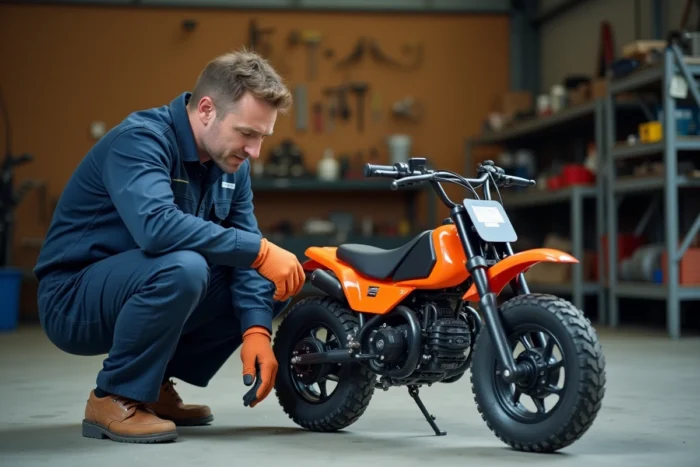
The Yamaha Piwi 80 (PW80) is a non-homologated motorized vehicle under French law. Produced between 1983 and 2012, this two-stroke mini-motorcycle has never received a CE approval, which places it in a very different legal category from a scooter or a road motorcycle. Understanding this distinction is the starting point for knowing where, how, and under what conditions to ride a Piwi 80 in France.
CE Approval and Piwi 80: Why Registration is Impossible
CE approval is the administrative act certifying that a vehicle meets the technical standards required by the European Union for its circulation on public roads. Without this approval, a vehicle cannot obtain a registration certificate or license plate.
The PW80 was never designed to meet these standards. It lacks compliant signaling lights, turn signals, and a braking system that meets road requirements. No procedure allows for the registration of a Piwi 80, even through a technical inspection or mechanical modification. The regulatory framework simply does not provide for a post-hoc homologation procedure for this type of vehicle.
To fully understand what the law says about the Piwi 80, it is essential to remember that its legal status classifies it among vehicles not authorized to circulate on public roads, just like a motocross bike, a pocket bike, or a pit bike.
DICEM Declaration: A Legal Obligation Often Ignored

The DICEM (Declaration of Motorized Vehicles) system applies to any non-homologated vehicle whose speed can exceed 25 km/h by design and which is not authorized to circulate on public roads. The Piwi 80 falls into this category.
The declaration must be made within 48 hours of purchase, whether the transaction occurs between individuals, with a professional, online, or even abroad. The procedure is carried out via the DICEM online service using FranceConnect.
Specifically, the seller declares the transfer, and then the buyer confirms the acquisition on the platform. This mechanism serves to trace the ownership chain of non-homologated vehicles, particularly to facilitate investigations in the event of an accident or theft.
What the DICEM Declaration Is Not
The DICEM declaration does not replace a registration certificate. It does not confer any right to circulate on public roads and has no homologation value. A Piwi 80 owner declared in DICEM remains subject to all usage restrictions applicable to non-homologated vehicles.
Private Land and Closed Circuit: The Only Authorized Riding Locations
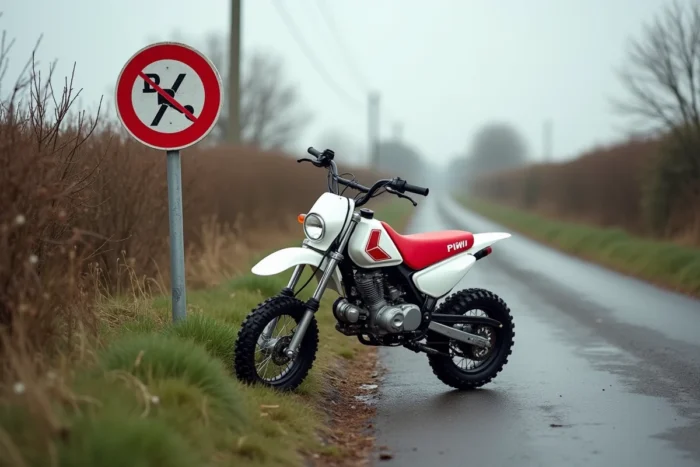
The Piwi 80 can legally ride only on strictly private land or a closed circuit not open to public traffic. A communal path, a forest trail, a residential cul-de-sac, or a supermarket parking lot are not considered private land under the law, even if they seem isolated.
The penalties for circulating on public roads are significant. The vehicle can be immobilized and towed. The driver faces a fine, and if the vehicle is not declared in DICEM, the penalties may be increased.
Usage Conditions for Minors
The rules differ depending on the age of the driver:
- Children under 15 cannot buy or use a non-homologated vehicle outside a supervised environment (driving school, family land under adult supervision)
- Young people aged 15 to 17 can use a non-homologated vehicle but cannot purchase it themselves, with the purchase needing to be made by a responsible adult
- From 18 years old, purchasing, renting, and using are free, respecting the rules of private land and declaration
Civil Liability Insurance: Mandatory Even Off-Road
A point often underestimated by Piwi 80 owners: civil liability insurance is mandatory, even for use exclusively on private land. Any motorized land vehicle must be insured, regardless of whether it operates on the road or not.
Home insurance contracts generally do not cover damages caused by a motorized vehicle. A specific civil liability insurance contract for non-homologated vehicles must be taken out. Several insurers offer this type of coverage, often for just a few dozen euros per year.
In the event of an accident without insurance, the owner incurs personal liability for all bodily and material damages. The Guarantee Fund for Mandatory Insurance (FGAO) can compensate the victim and then seek reimbursement from the uninsured responsible party for the amounts paid.
Documents to Keep
- The DICEM declaration certificate, which proves the traceability of the vehicle
- The valid and up-to-date civil liability insurance certificate
- The purchase invoice or transfer certificate, useful in case of inspection or resale
Second-Hand Sale and Transfer of Ownership of a Piwi 80
When reselling a Piwi 80, the seller must make the transfer declaration on DICEM before handing over the vehicle to the buyer. The buyer then has 48 hours to confirm the acquisition on the platform via FranceConnect.
Without this double declaration, the seller remains legally considered the owner of the vehicle. In the event of an accident caused by the new owner, the seller may be held liable if no transfer has been recorded.
The Piwi 80 remains a popular machine in the second-hand market, but its legal status imposes obligations that many sellers and buyers are unaware of. DICEM declaration, specific civil liability insurance, limited use to private land: these three pillars are not optional. Neglecting them exposes one to financial penalties and personal civil liability in the event of a claim.