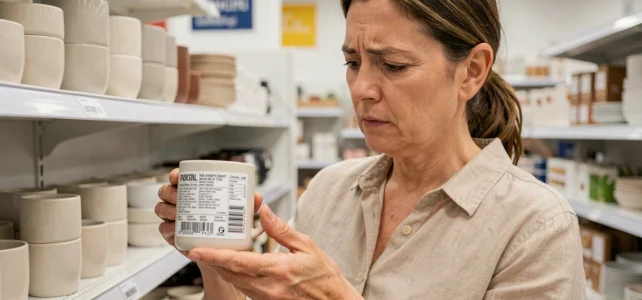
You may have returned a vintage item, an antique toy, or a small electronic device, and read on the label the mention “Made in EEC”. Three letters that do not correspond to any country on a map. This inscription, inherited from a time when the European Community had only a handful of members, continues to circulate in second-hand markets and in some old stocks. Understanding its meaning allows for a better assessment of a product’s actual origin and helps adjust your purchasing criteria.
EEC, CEE, EU: decoding the acronyms on a product label
EEC stands for European Economic Community, the English translation of Communauté économique européenne (CEE). This common market, established by the Treaty of Rome in 1957, originally included six countries: France, West Germany, Italy, Belgium, the Netherlands, and Luxembourg.
The CEE then expanded in successive waves. When the Maastricht Treaty came into force in 1993, the European Economic Community was replaced by the European Union. After 1993, the acronym EEC no longer has official value. Products manufactured in the EU now bear the mention “Made in EU” or the name of the member country.
Why does this matter for a buyer? An item stamped “Made in EEC” must have been manufactured before 1993, or at the latest during the transitional years when old packaging was still being sold. It is an indicator of age, not a guarantee of superior or inferior quality. If you are looking to understand precisely what made in EEC means, it is primarily a question of historical context and rules of origin.

European rules of origin: what “made in” really proves
A common misconception is to think that a product marked “Made in EEC” (or “Made in EU”) was entirely manufactured on European soil. The legal origin of a product does not guarantee that every component comes from Europe.
The rules of origin, defined by the Union Customs Code, are based on a specific criterion: the last substantial transformation. A good may contain raw materials from China or components assembled in Southeast Asia. If the transformation deemed decisive (for example, the making of a garment from imported fabrics) takes place in a member state, the product can bear the European mention.
What this changes for your purchases
Two products stamped “Made in EEC” could therefore have very different manufacturing chains. One fully machined in Germany, the other assembled in Italy from imported parts. The origin label indicates the country of the last transformation, not a percentage of local added value.
This mechanism has not fundamentally changed with the transition to the EU. It remains the same for current products marked “Made in EU” or “Made in France”. The mention of origin remains optional for most manufactured goods in the European Union, unlike certain food products where it is mandatory.
Digital product passport: traceability that replaces the label
The physical label “Made in…” has long been the only reference for consumers. This reference is evolving with the digital product passport, established by the ESPR regulation (Regulation (EU) 2024/1781). The central register of these passports has been operational since 2026.
This digital passport allows tracing data on a product’s life cycle: composition, reparability, recyclability, and origin information. Specifically, a QR code or NFC chip on the product provides access to a detailed sheet, much richer than a simple “Made in” mention.
Limitations to know before relying on it
The digital product passport does not automatically certify that a good is “made in Europe”. Here are the key points to remember:
- The presence of a European manufacturer or an address in the EU in the passport is not sufficient to establish origin in the legal sense.
- A CE marking on the product certifies compliance with European safety standards, not the place of manufacture.
- Only customs origin rules determine whether a product can legally bear the European mention.
The digital passport improves transparency, but it does not replace a formal origin verification. For a buyer, it serves as a complementary tool, not a provenance label.
Impact on your purchases: vintage, second-hand, and current products
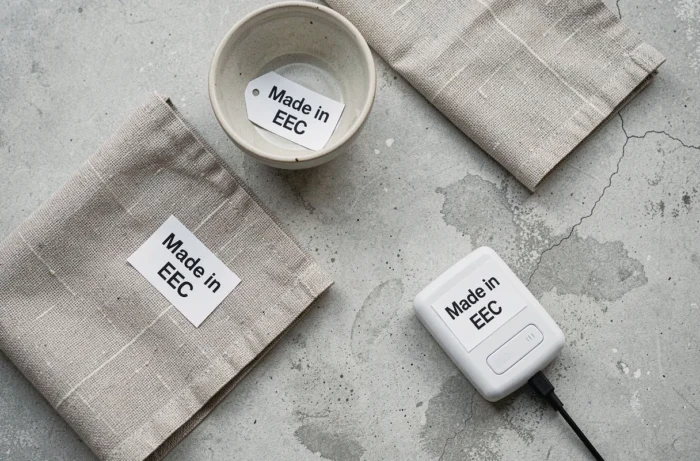
The marking “Made in EEC” mainly concerns three categories of products today: collectibles, old electronic equipment, and vintage clothing. On resale platforms, this mention is sometimes highlighted as a quality or authenticity argument.
A product “Made in EEC” is neither better nor worse than a current product “Made in EU”. Manufacturing standards have significantly evolved since 1993, particularly regarding material safety, allowed chemicals, and environmental protection. A toy made in the 1980s does not meet the same restrictions as a toy compliant with current regulations.
Concrete criteria for evaluating a product stamped EEC
- Check for the presence of other markings (manufacturer’s name, specific country) to refine the actual origin.
- For electrical devices, ensure that safety standards match current standards before plugging them in.
- In the collectibles market, the mention “Made in EEC” may increase the perceived value of an item, but it does not alone constitute a rarity criterion.
- Always compare with current standards if you plan to use the product daily, especially for cosmetics, toys, or small devices.
The inscription “Made in EEC” remains a marker of its time. It tells the story of a common market under construction, with labeling rules less regulated than today. For an informed purchase, cross-reference this information with the specific country of manufacture, the condition of the product, and its compliance with current European standards.